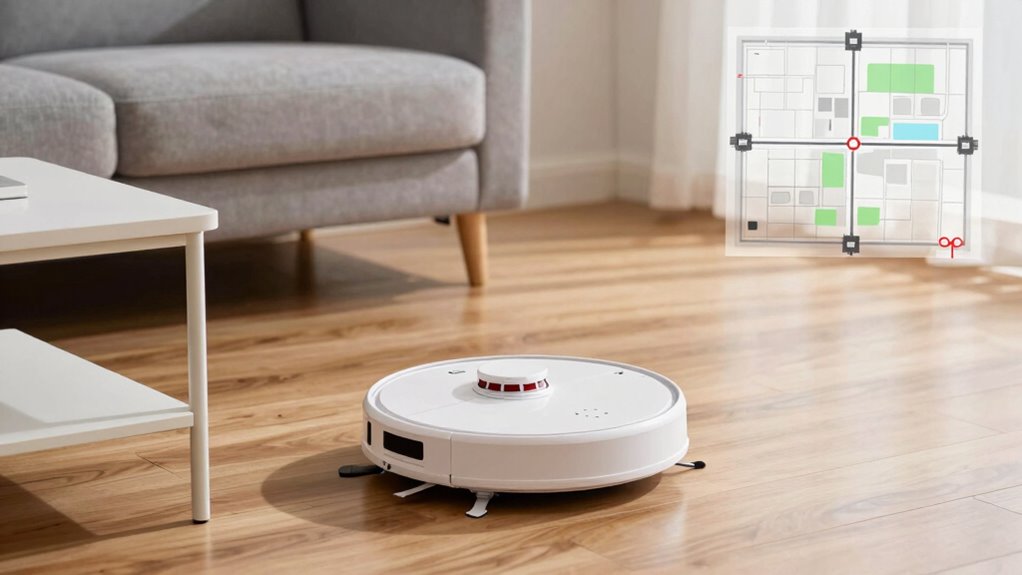

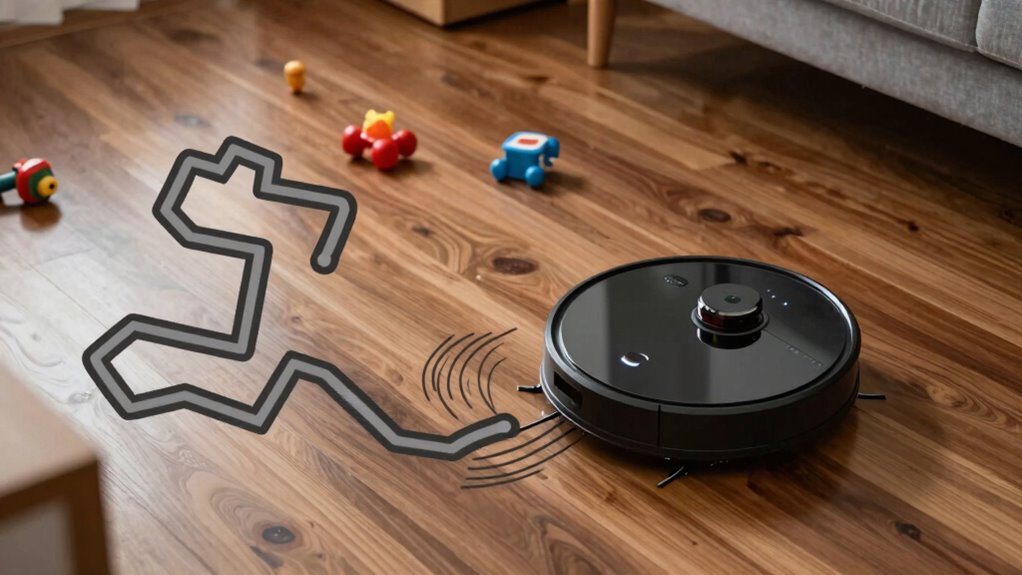
Robot vacuum navigation types mainly include random and systematic models. Random vacuums move in a haphazard way, bouncing off objects, which can cause missed spots and repeats. Systematic vacuums use advanced tech like laser sensors or cameras to create detailed maps, allowing for precise, efficient cleaning around obstacles. This smarter navigation enhances coverage and reduces cleaning time. If you’re curious about how these technologies work and which might suit your home best, keep exploring for more details.

Get the little things that make your day delivered free with Prime
- Fast, free delivery on millions of items
- Prime Video, Amazon Music and more included
- Member-only deals all year
Key Takeaways
- Random navigation moves unpredictably, bouncing off obstacles, and may miss spots or repeat areas.
- Systematic navigation uses sensors or cameras to create detailed maps for precise cleaning paths.
- Advanced navigation combines sensors with machine learning to adapt to home layouts and recognize objects.
- Laser and camera-based systems improve obstacle avoidance and enable efficient, straight-line routes.
- Navigation type significantly impacts cleaning thoroughness, speed, and the robot’s ability to handle complex environments.
Have you ever wondered how robot vacuums efficiently navigate your home? The way these devices move around and clean relies heavily on their navigation technology. The top-tier models use advanced systems to guarantee they cover every inch of your space without missing spots or wasting time. Central to this process are their mapping accuracy and obstacle avoidance capabilities. When a robot vacuum has high mapping precision, it can create a detailed map of your home, recognizing walls, furniture, and even small objects. This detailed map allows it to plan the most efficient cleaning route, reducing the chances of going over the same area repeatedly or missing spots. Obstacle avoidance is equally vital because it enables the robot to detect and navigate around furniture, cords, and other obstacles without getting stuck or causing damage. Together, these features determine how effectively a robot vacuum can clean your home. navigation technology plays a crucial role in how these devices adapt to different home layouts and obstacles.
There are primarily two navigation types to understand: random and systematic. Random navigation models are the simpler, more affordable options. They move in a seemingly haphazard pattern, bouncing off walls and furniture. While they can do a decent job, their mapping accuracy isn’t as refined, which sometimes results in missed spots or unnecessary repetitions. Obstacle avoidance sensors help these vacuums detect barriers, but because of their less precise navigation, they might bump into objects more often or get stuck in tight corners. Systematic navigation, on the other hand, uses more sophisticated technology to map out your entire home. These vacuums typically employ laser sensors or cameras to scan the environment, creating a detailed map that guides their movements. This approach not only improves mapping precision but also enhances obstacle avoidance, allowing the robot to plan efficient, straight-line paths and navigate tight spaces smoothly. The integration of mapping accuracy and obstacle detection technology is essential for optimal cleaning performance. In addition, advancements in navigation algorithms continue to improve how well these devices adapt to dynamic home environments. As sensor technology advances, the ability of these vacuums to operate seamlessly around various obstacles becomes even more impressive.
Some top-tier models combine both local sensors and mapping technology, enabling them to adapt to changes in your home, such as moved furniture or new obstacles. They can remember areas they’ve cleaned and avoid redundant passes, saving time and battery life. Others use camera-based navigation, which offers a broader sensory input, helping the robot recognize and maneuver around objects more reliably. As machine learning advances, these devices are becoming even smarter at adjusting their cleaning patterns based on your home’s unique layout. Ultimately, the choice of navigation type impacts how thoroughly and quickly your home gets cleaned. Understanding these differences can help you select a robot vacuum that matches your cleaning needs, guaranteeing your floors stay spotless without you having to supervise every move.
robot vacuum with laser navigation
As an affiliate, we earn on qualifying purchases.
As an affiliate, we earn on qualifying purchases.
Frequently Asked Questions
How Do Robot Vacuums Avoid Falling Down Stairs?
You might wonder how robot vacuums avoid falling down stairs. They use stair sensors and obstacle detection technology to identify edges and drop-offs. When these sensors detect a significant change in height or an open space, the vacuum pauses or changes direction to prevent falls. This smart navigation keeps your stairs safe from accidents, ensuring your vacuum cleans efficiently without risking damage or safety hazards.
Can Robot Vacuums Learn and Adapt Over Time?
Yes, robot vacuums can learn and adapt over time. They use machine learning and adaptive technology to improve their cleaning patterns based on your home’s layout and obstacles. As you use your vacuum, it analyzes data to optimize navigation, avoid obstacles more effectively, and cover areas efficiently. This continuous learning process helps your robot vacuum become smarter and more efficient, making cleaning faster and more thorough with each use.
What Is the Average Battery Life of a Robot Vacuum?
Think of your robot vacuum’s battery life like a marathon runner’s stamina—lasting around 90 to 120 minutes on a full charge. The battery longevity depends on your model, and charging efficiency can make a big difference in reducing downtime. Some vacuums have quick-charge features, so they’re ready to go faster. Keep an eye on the battery health, and your device will stay a trusty cleaner for years to come.
Do Different Navigation Types Affect Cleaning Speed?
Yes, different navigation types impact cleaning speed. For example, systematic navigation offers higher accuracy, allowing your robot to clean efficiently without missing spots, which can speed up the process. Random navigation might be slower since it covers areas less predictably. Your choice affects cleaning efficiency, with more precise navigation enabling quicker, more thorough results. So, consider your home’s layout when selecting a navigation type to optimize cleaning speed.
Are There Specific Room Types Better Suited for Certain Navigation?
Yes, certain room types suit specific navigation styles better. If your room has a simple layout with fewer furniture obstacles, a systematic navigation works efficiently, covering every area quickly. However, in cluttered or complex spaces with many obstacles, adaptive or reactive navigation helps the robot maneuver around furniture more effectively. Your room’s layout influences how well different navigation types perform, impacting your cleaning experience.
As an affiliate, we earn on qualifying purchases.
Conclusion
Just like a seasoned sailor chooses the right compass for smooth sailing, understanding your robot vacuum’s navigation is key to a spotless home. Whether it’s the meticulous grid or the free-spirited random pattern, each type charts its course through your space. By knowing their navigation style, you steer your cleaning adventures with confidence, turning a simple chore into a well-orchestrated voyage. With the right navigation, your home’s cleanliness becomes an effortless, rhythmic dance.
robot vacuum obstacle avoidance sensors
As an affiliate, we earn on qualifying purchases.
As an affiliate, we earn on qualifying purchases.
As an affiliate, we earn on qualifying purchases.
Halloween Picks
halloween
As an affiliate, we earn on qualifying purchases.