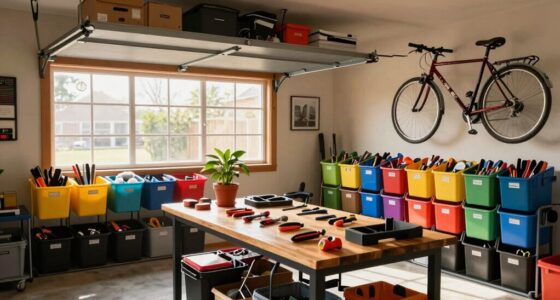
A good shop light setup features bright, even illumination that covers every corner without creating dark spots. You should install LED fixtures in a grid or along the ceiling length, positioned high enough to prevent shadows but close enough for sufficient brightness. Combine general overhead lights with task-specific fixtures aimed directly at work surfaces. Test and adjust the lighting to guarantee safety and comfort. Keep exploring for more tips to perfect your shop’s lighting layout.

Get the little things that make your day delivered free with Prime
- Fast, free delivery on millions of items
- Prime Video, Amazon Music and more included
- Member-only deals all year
Key Takeaways
- Even, shadow-free illumination achieved through overhead LED fixtures arranged in a grid or along the ceiling length.
- Proper fixture placement ensures bright, uniform coverage without creating dark spots or glare.
- Combining general ambient lighting with adjustable task lights improves visibility for detailed work.
- Fixtures are mounted high enough to prevent shadows, with beam angles optimized for coverage and focus.
- Final testing and adjustments ensure safety, comfort, and efficiency by achieving balanced, well-distributed light.

Are you ready to illuminate your workspace effectively? A good shop light setup isn’t just about tossing in a few bulbs and hoping for the best. It’s about strategic placement and choosing the right lighting technology, like LED illumination, to ensure your workspace is bright, safe, and efficient. When you focus on fixture placement, you control shadows, glare, and dark spots, making it easier to see details and work comfortably for hours.
First, consider the layout of your shop. You want your lighting to cover the entire area without creating unnecessary dark corners. Proper fixture placement involves installing lights overhead, ideally in a grid pattern or along the ceiling’s length, depending on the shape of your shop. Think about mounting fixtures high enough to prevent shadows cast by objects or tools, but not so high that the light loses intensity. LED fixtures are perfect here because they emit bright, even light while consuming less energy and generating less heat. This means you can position them closer to your work surfaces without worrying about overheating or excessive power costs. Additionally, choosing the right lighting technology ensures your setup is both energy-efficient and effective over time.
Next, focus on task lighting. While general overhead LED illumination provides overall brightness, you’ll also want specific fixtures aimed directly at your workbenches, machinery, or detailed projects. Position these task lights carefully—aim them at your work surface, but avoid glare hitting your eyes. Adjustable LED fixtures work well because they let you direct light exactly where it’s needed, reducing eye strain and increasing precision. The key is to combine ambient lighting with task-specific illumination, so every part of your workspace is well-lit without creating harsh shadows or reflections. Incorporating layered lighting can help achieve the perfect balance of brightness and focus across your shop. To optimize your setup further, consider the biodiversity of your workspace environment, ensuring lighting choices are eco-friendly and sustainable. Paying attention to light distribution can also help prevent uneven lighting and enhance visibility throughout your shop.
Another important aspect is fixture placement relative to your work zones. For example, if you often work on small, intricate pieces, install lighting directly above or slightly in front of your work area. For larger projects, broader coverage with multiple fixtures ensures consistent brightness. When installing LED fixtures, consider their beam angle to maximize coverage and minimize dark spots. Proper fixture placement also involves avoiding placement where lights might cast shadows over your work or cause glare that hampers visibility.
Finally, always test your setup before permanently fixing fixtures. Turn on the lights, move around the shop, and see if the illumination is even and sufficient. Adjust fixture placement if necessary, aiming for uniform light distribution. With the right combination of LED illumination and strategic fixture placement, your shop will be a safer, more productive environment, where you can work comfortably and efficiently on every project.
Products Worth Considering

Philips Hue Festavia Globe Outdoor String Lights, 8 Bulbs, 22 ft

Sonos Era 100 Wireless Smart Speaker, Black

Levoit Vital 100 Air Purifier for Home Bedroom
As an affiliate, we earn on qualifying purchases.
Frequently Asked Questions
How Many Lights Do I Need for My Shop?
You’ll likely need at least four to six LED shop lights for good coverage, but it depends on your shop’s size. Make certain your lights have flicker-free LED technology to prevent flickering issues and include power surge protection to safeguard your setup. Proper placement ensures even lighting, reducing shadows and glare. Adjust the number based on your workspace, but prioritize quality lights with these features for a safe, efficient shop environment.
What Is the Best Color Temperature for Shop Lighting?
Ironically, the best color temperature for shop lighting isn’t some mystical number but usually around 5000K to 6500K. This light color closely mimics daylight, helping you see details clearly and accurately. Using a cooler color temperature enhances visibility and reduces eye strain, making your work easier and safer. So, opt for this range to make certain your shop is well-lit, productive, and visually comfortable—no magic required.
How Do I Prevent Shadows in My Workspace?
To prevent shadows in your workspace, focus on strategic lighting placement, positioning lights evenly around your area. Use multiple light sources at different angles to minimize shadow creation. Incorporate light diffusion, such as diffusers or softboxes, to spread light evenly and soften harsh shadows. Adjust the height and angle of your lights regularly, ensuring they illuminate your work from all sides, creating a bright, shadow-free environment.
What Safety Precautions Should I Consider With Shop Lights?
Think of your shop lights as guiding stars—safety first. You should guarantee they’re securely mounted, avoid exposed wiring, and use fixtures with proper insulation. Prioritize energy efficiency by choosing LED lights, and look for flicker reduction features to protect your eyes. Always turn off power before maintenance, keep lights away from flammable materials, and regularly inspect for damage. These precautions create a safer, more efficient workspace.
Can I Install Shop Lights Myself or Hire a Professional?
You can definitely install shop lights yourself if you’re comfortable with electrical work, but hiring a professional guarantees safety and code compliance. DIY installation might save money upfront, but a professional can optimize energy efficiency and provide a better cost comparison over time. If you’re unsure about wiring or safety, it’s best to hire an electrician. This way, you get a reliable setup that saves energy and reduces long-term costs.
Conclusion
A well-designed shop light setup transforms your workspace, making it safer and more efficient. Remember, proper lighting can reduce eye strain and improve accuracy, saving you time and effort. Did you know that adequate lighting can boost productivity by up to 30%? So, invest in quality fixtures and strategic placement—your eyes and your projects will thank you. With the right setup, your shop becomes a brighter, more enjoyable place to work.