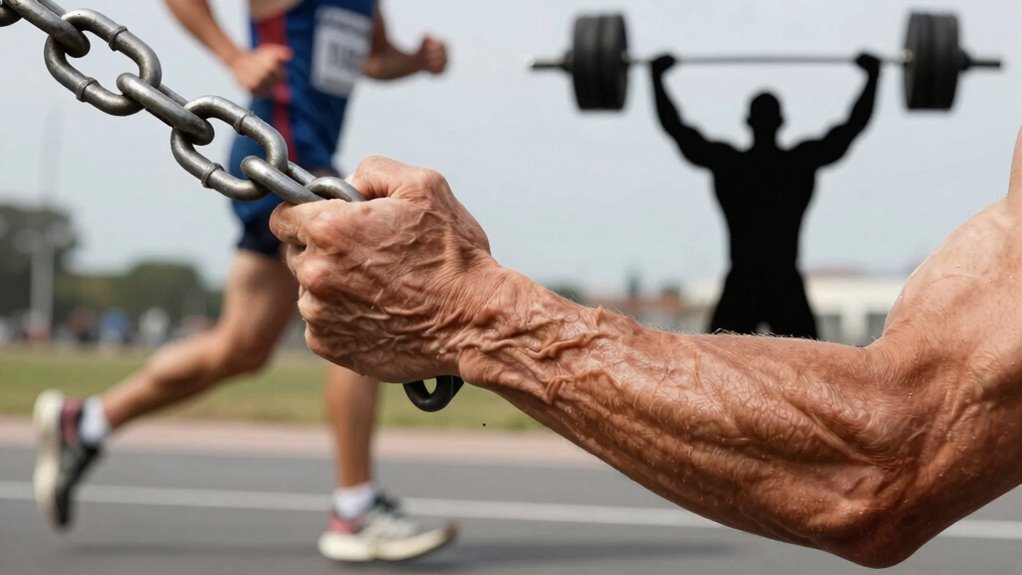
Power is about explosive movements, helping you produce force quickly, like jumping or sprinting. Strength focuses on lifting heavy weights to increase your maximum force capacity, without necessarily being fast. Endurance is all about sustaining activity over time, such as running long distances, by improving your muscles’ efficiency and fatigue resistance. Each targets different muscle fibers and training styles. Keep going, and you’ll discover how to tailor your workouts for each goal.

Get the little things that make your day delivered free with Prime
- Fast, free delivery on millions of items
- Prime Video, Amazon Music and more included
- Member-only deals all year
Key Takeaways
- Power emphasizes explosive movements and rapid force production, primarily engaging fast-twitch muscle fibers.
- Strength focuses on maximizing the amount of force muscles can generate, often through heavy lifting.
- Endurance involves sustained activity over time, enhancing fatigue resistance and slow-twitch fiber efficiency.
- Power combines speed and strength for quick, high-intensity actions; strength builds overall force capacity; endurance sustains prolonged effort.
- Different training methods target specific muscle fibers and adaptations to develop power, strength, or endurance.

Understanding the difference between power, strength, and endurance is essential for optimizing your fitness goals. Each one targets different aspects of your muscles and influences your training choices. To grasp these differences, it’s helpful to deliberate muscle fiber types and training adaptations. Your muscles aren’t uniform; they’re made up of various fiber types that respond differently to different stimuli. Fast-twitch fibers, for example, are designed for explosive movements, producing quick bursts of power and high force output. Slow-twitch fibers, on the other hand, excel at sustained, low-intensity activities, like long-distance running. Training adaptations—how your muscles change in response to exercise—are closely tied to these fiber types. When you focus on power, your training stimulates fast-twitch fibers to generate maximum force rapidly. Strength training also targets these fibers but emphasizes lifting heavier weights with fewer repetitions, prompting muscular adaptations that increase your ability to exert force. Endurance training, however, primarily enhances slow-twitch fibers, improving your muscles’ efficiency and capacity for prolonged activity. Understanding these distinctions helps you tailor your workouts to your goals.
Power is all about explosive, high-intensity movements that require rapid force production. Think of jumping, sprinting, or throwing—actions that demand a quick burst of energy. Power training often involves plyometrics, Olympic lifts, or medicine ball throws. These exercises stimulate fast-twitch fibers to adapt, increasing your ability to generate force in a short amount of time. Strength, meanwhile, is about increasing the maximum amount of force your muscles can produce. When you lift heavy weights with low reps, your muscles undergo adaptations that improve their overall force capacity. This doesn’t necessarily mean you’ll become faster or more explosive, but your muscles become more capable of handling heavy loads. Endurance focuses on sustaining activity over extended periods, like running a marathon or cycling long distances. It involves lighter loads, higher repetitions, and longer durations, which promote adaptations in slow-twitch fibers, improving your muscles’ efficiency, capillary density, and fatigue resistance.
As an affiliate, we earn on qualifying purchases.
Frequently Asked Questions
How Do Power, Strength, and Endurance Training Overlap?
Power, strength, and endurance training overlap through neurological adaptation and muscle hypertrophy. When you train for any of these, your nervous system becomes more efficient, allowing you to recruit muscles more effectively. Additionally, muscle hypertrophy occurs as your muscles grow stronger and larger, benefiting all three areas. This overlap means that incorporating elements of each training type can enhance overall performance, making your workouts more effective and well-rounded.
Can You Improve All Three Simultaneously?
Yes, you can improve all three simultaneously, but it’s like juggling fire—requires careful planning. Incorporate varied training to boost muscle hypertrophy, power, and endurance. Focus on progressive overload for strength, explosive movements for power, and sustained efforts for endurance. This balanced approach not only enhances overall performance but also aids injury prevention, ensuring your muscles stay resilient and capable of handling diverse physical demands.
What Are the Best Exercises for Each Attribute?
To build power, focus on explosive movements like plyometric jumps and Olympic lifts, which boost muscle hypertrophy and generate rapid force. For strength, prioritize heavy resistance exercises such as squats and deadlifts, emphasizing muscle growth and neural adaptation. Improve endurance with steady-state cardio like running or cycling, enhancing cardiovascular efficiency. Incorporate a balanced routine targeting all three attributes to develop a well-rounded fitness profile.
How Do These Qualities Affect Athletic Performance?
Think of power, strength, and endurance as the engine, the chassis, and the fuel of your athletic vehicle. Power boosts your muscle hypertrophy, allowing explosive moves. Strength provides a sturdy chassis, supporting heavy lifts and stability. Endurance fuels your cardiovascular capacity, helping you sustain effort during long performances. Together, these qualities optimize your athletic performance, enabling you to excel in various sports by maximizing your body’s potential and resilience.
Are There Specific Diets to Enhance Each?
Yes, specific diets can enhance power, strength, and endurance. For power, focus on carbohydrate-rich meals with timing around workouts, and consider creatine supplements to boost explosiveness. Strength athletes benefit from high-protein diets with adequate carbs and fats, along with amino acid supplements. Endurance performers should prioritize carbohydrate loading and maintain balanced nutrition, utilizing electrolyte supplements during prolonged activity. Proper nutritional timing and targeted supplement strategies optimize each trait’s development and performance.
Olympic weightlifting barbell set
As an affiliate, we earn on qualifying purchases.
As an affiliate, we earn on qualifying purchases.
Conclusion
Think of your fitness as a toolbox—power, strength, and endurance are your essential tools. You wouldn’t use a hammer to tighten a screw, just like you shouldn’t rely on only one trait for every challenge. For example, a sprinter needs power for quick bursts, while a marathon runner relies on endurance. By understanding and balancing these qualities, you’re better equipped to tackle any goal, transforming your body into a versatile, well-rounded machine.
resistance training bands for endurance
As an affiliate, we earn on qualifying purchases.
As an affiliate, we earn on qualifying purchases.
medicine ball for explosive power
As an affiliate, we earn on qualifying purchases.
As an affiliate, we earn on qualifying purchases.
Halloween Picks
halloween
As an affiliate, we earn on qualifying purchases.