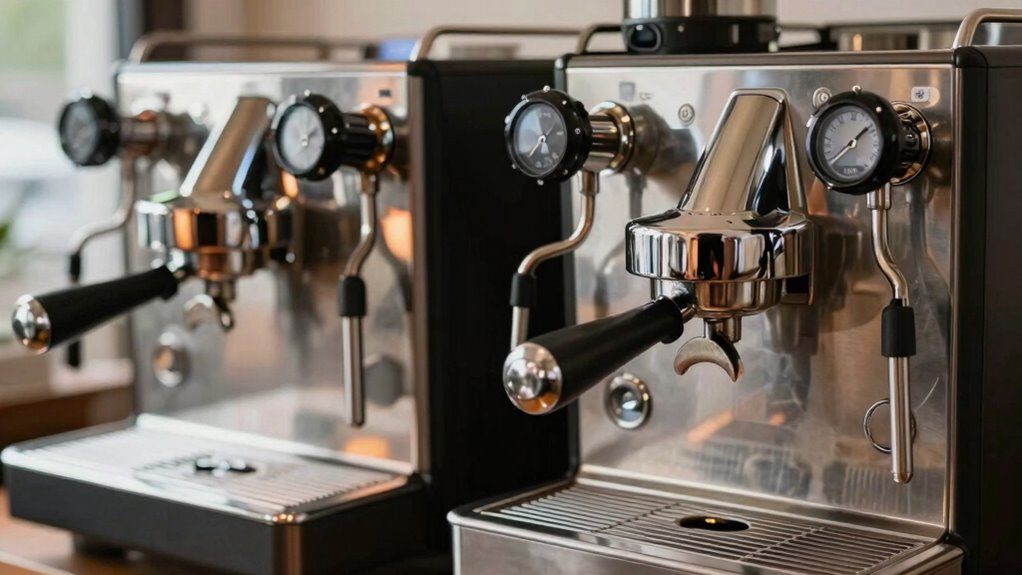

If you need a versatile, space-saving option for occasional brewing, a heat exchanger suits your workflow because it’s cheaper and easier to maintain, though you might face longer wait times for steaming. On the other hand, if you want to streamline multiple drinks quickly or work in a busy environment, a dual boiler fits better, offering independent temperature control and simultaneous brewing and steaming. Continue to explore to find which system aligns best with your specific needs.

Get the little things that make your day delivered free with Prime
- Fast, free delivery on millions of items
- Prime Video, Amazon Music and more included
- Member-only deals all year
Key Takeaways
- Dual boilers enable simultaneous brewing and steaming, ideal for high-volume or busy environments.
- Heat exchangers suit intermittent use with manual temperature adjustments, fitting casual or less frequent brewing workflows.
- Dual boilers reduce wait times and streamline workflow, especially in professional settings.
- Heat exchangers may require more user intervention for temperature management during operation.
- Consider space constraints: heat exchangers are more compact, while dual boilers need more room for their larger size.
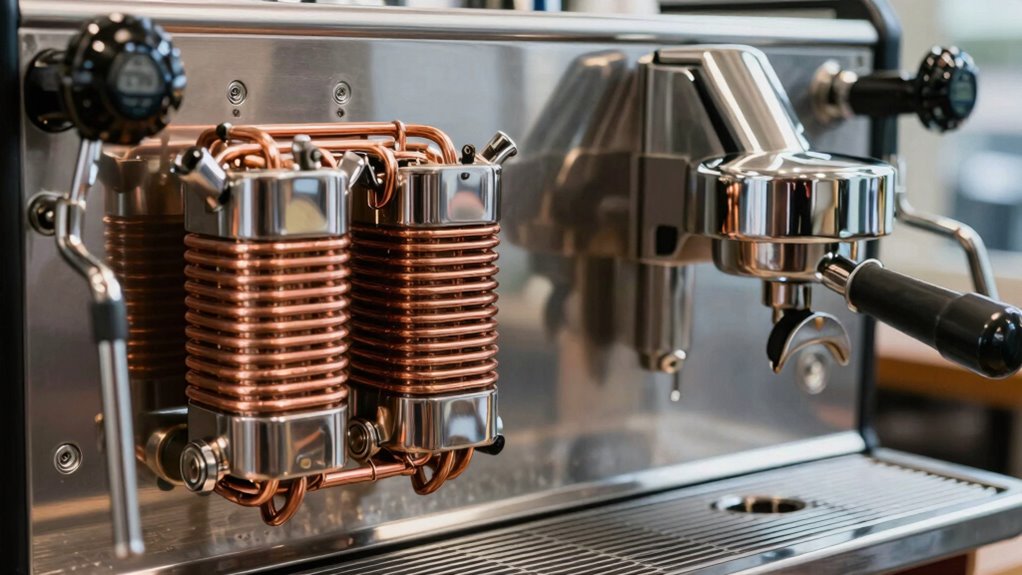
When choosing an espresso machine, understanding the difference between a heat exchanger and a dual boiler is essential, as each offers distinct advantages for brewing quality and convenience. The heat exchanger system heats water in a single boiler, passing it through a copper or brass tube to maintain the brewing temperature. This design generally comes with a lower upfront cost compared to dual boilers, making it appealing if you’re budget-conscious. However, you should consider the ongoing maintenance requirements — heat exchangers can accumulate mineral deposits more quickly, especially if your water isn’t filtered, leading to more frequent descaling. Cleaning the system thoroughly involves flushing the heat exchange tube and maintaining the boiler’s proper water levels, which can be a bit more involved over time. Additionally, mineral buildup can impact performance and longevity if not properly managed. Regular descaling and water filtration can help mitigate these issues and extend the lifespan of your machine. Using water quality management techniques can significantly influence the machine’s durability and performance.
On the other hand, dual boilers feature two separate heating systems: one dedicated to brewing espresso at a stable, ideal temperature, and another for steaming milk. This setup ensures temperature stability and allows you to brew and steam simultaneously, vastly improving workflow efficiency. The cost comparison favoring dual boilers shows they tend to be more expensive initially, often by a significant margin. Yet, this higher investment translates into less frequent maintenance, since each boiler operates independently and is easier to clean. Dual boiler machines usually have more sophisticated controls and are built with higher-quality materials, which further reduces the need for repairs and routine servicing. Moreover, the independent boilers system allows for better temperature control and consistency, especially during longer or more complex sessions.
Dual boilers offer stable temperatures, simultaneous brewing and steaming, and less maintenance despite higher initial costs.
In terms of workflow, a heat exchanger machine suits those who prioritize a lower upfront cost and are willing to spend a bit more time managing temperature stability manually. It’s ideal if you’re brewing intermittently or don’t need to steam milk while pulling shots. Conversely, a dual boiler fits well if you value speed and consistency — particularly in a busy environment or if you enjoy making multiple drinks in quick succession. The ability to brew and steam simultaneously streamlines your process, saving you time and reducing the hassle of waiting or adjusting temperatures during your session. The trade-off is that dual boilers require a larger physical footprint and a higher initial investment, but their reduced maintenance needs often make up for it in the long run.
Ultimately, your choice hinges on your workflow preferences, budget, and willingness to perform maintenance. If you want a straightforward setup with lower initial costs and don’t mind manual adjustments, a heat exchanger may be the way to go. If you need speed, consistency, and minimal fuss, investing in a dual boiler can offer a smoother, more reliable experience over time. Considering your kitchen space and how much room you can allocate for your equipment is also an important factor in making the best choice for your needs.
Products Worth Considering

Sonos Era 100 SL Compact Microphone-Free Speaker, Black

Bose SoundLink Flex Bluetooth Speaker (2nd Gen), Portable Waterproof Speaker, Black

Shark Rocket Pet Plus Corded Stick Vacuum, Bordeaux, HV322
As an affiliate, we earn on qualifying purchases.
Frequently Asked Questions
Which Machine Is More Durable Over Time?
You’ll find that dual boilers tend to be more durable over time because of their superior material longevity and component resilience. The separate boilers are built to handle frequent use without wearing out quickly, making them a reliable choice for long-term performance. In contrast, heat exchangers, while efficient, may experience more wear and tear, especially if used intensively. So, if durability is your priority, a dual boiler generally offers a longer-lasting investment.
Can Both Systems Be Upgraded Easily?
Upgrading either system is like renovating a house—you can often do it, but it depends on the design. Dual boilers generally offer more straightforward upgrades because of their modular parts, while heat exchangers may require more extensive work. Your customization options and cost implications influence this choice. If you want easier upgrades, a dual boiler might be better, but consider your budget and desired features before deciding.
How Do Maintenance Requirements Differ?
You’ll find that maintenance requirements differ mainly in cleaning routines and component access. Dual boilers typically need more frequent cleaning because of their separate heating units, and accessing components can be more complex. Heat exchangers usually have simpler cleaning routines since they share a single system, making maintenance easier. Overall, with dual boilers, you’ll spend more time on upkeep, while heat exchangers require less frequent attention.
Are There Specific Coffee Profiles Suited for Each?
You’ll find that certain coffee profiles shine with each system. The dual boiler’s precise temperature control enhances extraction consistency, making it ideal for complex, nuanced flavors like single-origin or delicate light roasts. Meanwhile, the heat exchanger’s quick heat-up and stable temp work well for bold, full-bodied profiles like dark roasts. So, your choice depends on whether you prioritize precise extraction for subtle flavors or versatility for robust coffees.
Which System Is More Energy-Efficient?
A heat exchanger system generally uses less energy because it heats water on demand, making it more power-efficient during operation. In contrast, dual boilers maintain two separate boilers continuously, which consumes more energy due to constant heating. If you’re looking to minimize energy consumption and maximize power efficiency, a heat exchanger is the better choice. However, dual boilers can be more consistent for high-volume, professional settings.
Conclusion
Ultimately, choosing between a heat exchanger and a dual boiler is like selecting your own quest in the coffee domain. The heat exchanger offers a swift, focused adventure—perfect for those who crave speed and simplicity. Meanwhile, the dual boiler beckons with the promise of mastery, like the alchemist’s secret, allowing you to control every nuance. Whether you chase the legend of a perfect shot or embrace the challenge of precision, your workflow shapes your legendary brew.