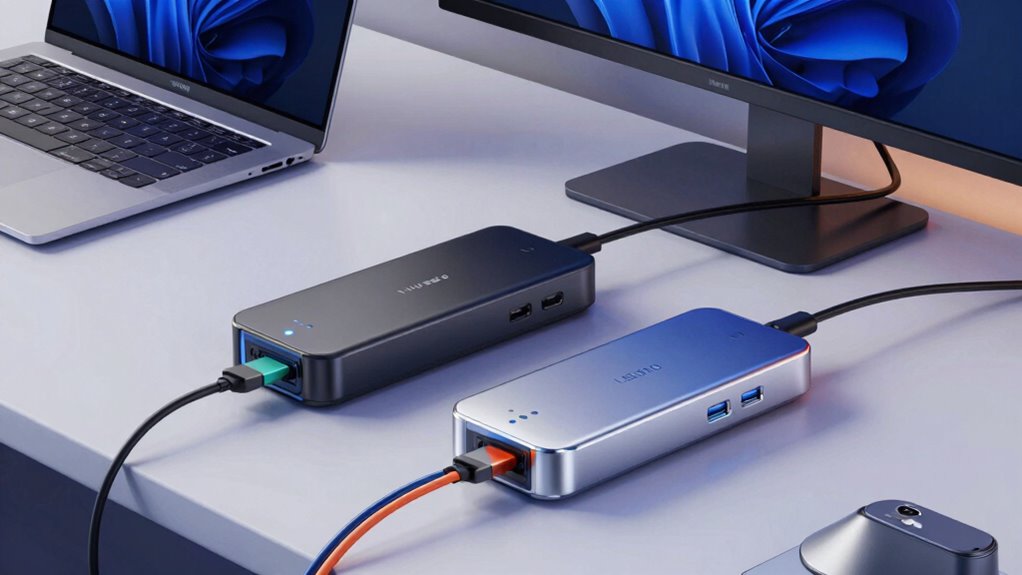

If you need lightning-fast data transfers and support for high-resolution displays, a Thunderbolt dock is your best choice, especially for professional media work. It offers higher speeds and stronger power delivery, making it ideal for demanding tasks. On the other hand, a USB-C dock provides reliable performance for everyday use, with broader compatibility and more budget-friendly options. To find out which suits your desk setup best, explore the details ahead.

Get the little things that make your day delivered free with Prime
- Fast, free delivery on millions of items
- Prime Video, Amazon Music and more included
- Member-only deals all year
Key Takeaways
- Thunderbolt docks offer faster data transfer (up to 40Gbps) suitable for professional media workflows, while USB-C supports up to 10Gbps for everyday tasks.
- Thunderbolt provides higher power delivery (up to 100W) ideal for demanding devices, compared to USB-C’s typical 85W.
- Thunderbolt docks feature more advanced ports like HDMI, DisplayPort, and Ethernet, enhancing connectivity options for complex setups.
- USB-C docks are more widely compatible across devices and are a cost-effective choice for general use.
- Choose Thunderbolt for high-performance, professional setups; opt for USB-C for versatility and budget-friendly needs.
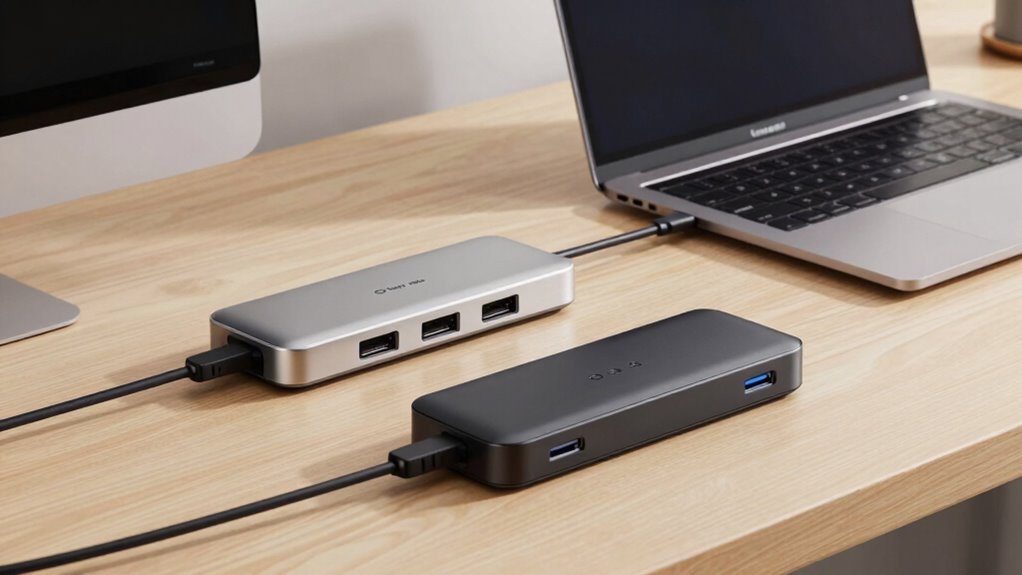
Choosing the right dock can considerably improve your desk setup, but with options like Thunderbolt and USB-C, it’s easy to get overwhelmed. Both types of docks offer impressive features, but understanding their differences helps you pick the best fit. If you want fast data transfer, high power delivery, and added convenience like wireless charging, knowing which port type supports your needs is key.
Thunderbolt docks stand out for their exceptional speed and versatility. They support transfer rates up to 40Gbps, making them ideal if you regularly work with large files, video editing, or need quick backups. Thunderbolt docks often include multiple Thunderbolt ports, USB-C, HDMI, DisplayPort, and Ethernet, giving you a *thorough* connection hub. Plus, many support wireless charging capabilities, letting you power up compatible devices without cluttering your desk with extra cables. Power delivery is another strong suit of Thunderbolt docks; they can deliver up to 100W of power, so you can charge your laptop and peripherals simultaneously without needing separate chargers. This integration simplifies your workspace and reduces cable clutter, keeping your desk clean and efficient. Additionally, high-speed data transfer capabilities make Thunderbolt docks particularly suitable for professional workflows involving large media files. When considering a dock, it’s important to evaluate device compatibility to ensure seamless integration with your existing setup. Recognizing standardization differences can also help you avoid potential connection issues with your devices.
USB-C docks, on the other hand, offer broad compatibility and are usually more budget-friendly. They support data transfer speeds up to 10Gbps, which suffices for most daily tasks like document editing, web browsing, and video streaming. Many USB-C docks also incorporate wireless charging features, enabling you to conveniently charge your phone or wireless earbuds through the dock itself. Power delivery is another significant benefit—most USB-C docks provide up to 85W of charging power, enough to keep most laptops running without interruption. Because USB-C is a widely adopted standard, these docks tend to be compatible with a wider range of devices, whether you’re using Windows, macOS, or other systems.
The choice ultimately depends on what you prioritize. If you need the fastest data transfer, maximum power delivery, and advanced connectivity options, a Thunderbolt dock is your best bet. It’s especially suitable if you’re a professional working with intensive media files or multiple high-resolution displays. If you prefer a versatile, cost-effective solution for everyday tasks that still offers wireless charging and solid power support, a USB-C dock will serve you well. Both options can streamline your workspace, but understanding their capabilities ensures you make an informed decision that matches your workflow and device ecosystem.
As an affiliate, we earn on qualifying purchases.
Frequently Asked Questions
Can I Use a Thunderbolt Dock With a USB-C Port Laptop?
Yes, you can use a Thunderbolt dock with a USB-C port laptop if it supports Thunderbolt or Thunderbolt 3 technology. These docks typically provide power delivery and video output through the USB-C port, but make certain your laptop’s port supports Thunderbolt features. If it only supports standard USB-C, the dock may work for some functions but might not deliver the full Thunderbolt experience, such as high-speed data transfer or multiple high-resolution displays.
Are There Compatibility Issues Between Different Brands of Docks?
You might encounter compatibility issues between different brands of docks, especially if their firmware isn’t updated regularly. Brands may implement proprietary features or hardware standards that don’t always align perfectly. To avoid problems, make sure your dock’s firmware is current and check for compatibility notes from the manufacturer. This proactive approach helps you enjoy seamless connectivity, regardless of brand differences, and ensures your desk setup functions smoothly.
Do Docks Support Daisy-Chaining Multiple Devices?
Yes, many docks support multi-device chaining, especially Thunderbolt docks, allowing you to connect multiple peripherals through a single port. USB-C docks often support power delivery, making it easy to charge your device while connecting accessories. However, not all docks support extensive multi-device chaining, so check the specifications for compatibility with your peripherals and guarantee your dock provides sufficient power delivery for your setup needs.
How Do Docks Affect Overall Desk Space and Cable Management?
Docks help improve your desk setup by reducing cable clutter and optimizing space. They centralize connections, so you need fewer cables running everywhere, which keeps your workspace tidy. This streamlined approach frees up desk space and makes it easier to manage your devices. With a well-chosen dock, you’ll enjoy a cleaner, more organized setup that looks professional and functions efficiently, enhancing your overall productivity and comfort.
Are There Security Concerns With Thunderbolt or USB-C Docks?
Think of your dock as a trusted gatekeeper—secure, but not infallible. Both Thunderbolt and USB-C docks can pose security concerns, especially regarding data transfer and device vulnerabilities. For instance, a compromised port could allow data breaches or unauthorized access. To stay safe, keep firmware updated and use security features like device authentication. Being vigilant helps protect your setup, just like locking your front door keeps your home secure.
USB-C multiport dock with wireless charging
As an affiliate, we earn on qualifying purchases.
As an affiliate, we earn on qualifying purchases.
Conclusion
In the end, choosing between Thunderbolt and USB-C docks depends on your needs. If you prioritize speed and high-performance peripherals, Thunderbolt offers up to 40Gbps transfer rates, making it ideal for demanding tasks. On the other hand, USB-C provides versatility and broad compatibility at a more affordable price. Did you know that over 60% of new laptops now support USB-C? That makes it a solid, future-proof choice for most desk setups.
Thunderbolt vs USB-C dock comparison
As an affiliate, we earn on qualifying purchases.
As an affiliate, we earn on qualifying purchases.
high-speed Thunderbolt docking station
As an affiliate, we earn on qualifying purchases.
As an affiliate, we earn on qualifying purchases.
Halloween Picks
halloween
As an affiliate, we earn on qualifying purchases.