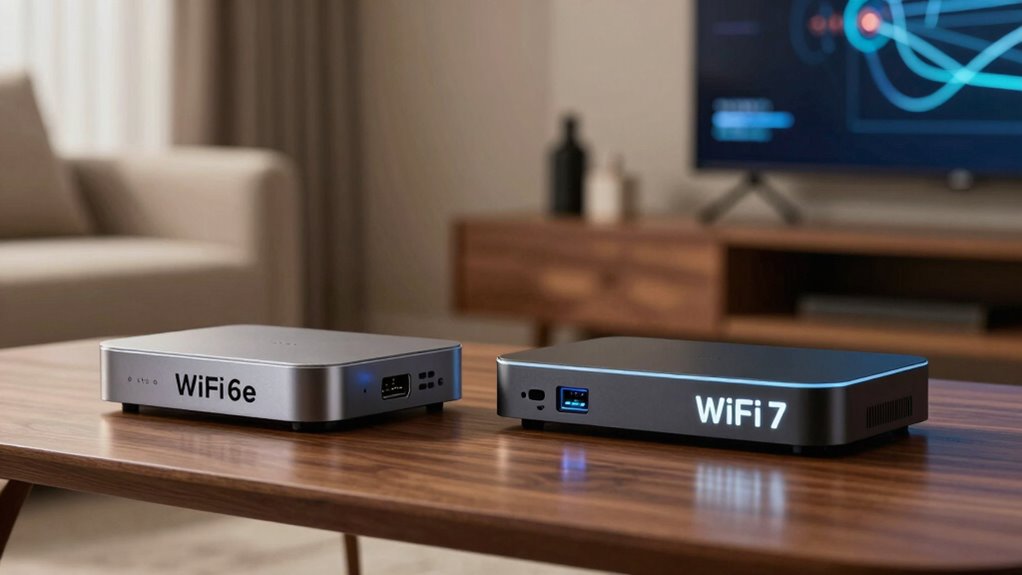

When comparing Wi-Fi 6E and Wi-Fi 7, the speed, latency, and compatibility differences matter considerably. Wi-Fi 6E supports existing devices with faster speeds on the 6GHz band, but Wi-Fi 7 offers speeds up to 46 Gbps and lower latency for gaming and streaming. If you’re thinking about future needs, Wi-Fi 7 is more robust for multiple devices. Consider cost and upgrade needs carefully. There’s more to explore about how each option fits your situation.
Key Takeaways
- Wi-Fi 6E offers faster speeds with the 6GHz band, while Wi-Fi 7 significantly boosts speeds up to 46 Gbps.
- Wi-Fi 7 features Multi-Link Operation (MLO) for enhanced throughput and reduced congestion in high-demand environments.
- Average latency for Wi-Fi 6E is 20-30 ms, while Wi-Fi 7 lowers it to 10-20 ms, benefiting gaming and streaming.
- Upgrading to Wi-Fi 7 may involve higher costs, but it provides long-term value and scalability for multiple devices.
- Both Wi-Fi 6E and Wi-Fi 7 ensure future compatibility and network longevity, essential for evolving smart home ecosystems.

TP-Link AXE5400 Tri-Band WiFi 6E Router (Archer AXE75), 2025 PCMag Editors' Choice, Gigabit Internet for Gaming & Streaming, New 6GHz Band, 160MHz, OneMesh, Quad-Core CPU, VPN & WPA3 Security
Tri-Band WiFi 6E Router – Up to 5400 Mbps WiFi for faster browsing, streaming, gaming and downloading, all…
As an affiliate, we earn on qualifying purchases.
As an affiliate, we earn on qualifying purchases.
What You Need to Know About Wi-Fi 6E and Wi-Fi 7 Before Upgrading
Before you think about upgrading your Wi-Fi, it’s vital to understand the key differences between Wi-Fi 6E and Wi-Fi 7. Both represent the latest Wi-Fi standards, but they come with distinct upgrade timelines and device requirements. Wi-Fi 6E supports existing devices, while Wi-Fi 7 may require newer hardware, raising compatibility concerns. Performance expectations are also different; Wi-Fi 7 is designed for more robust network infrastructure, catering to future developments in technology. As you analyze your cost, consider whether the benefits of upgrading justify the investment. Make sure your current devices can handle the improvements, and keep in mind that adopting Wi-Fi 7 could future-proof your setup, making it worthwhile in the long run.

TP-Link BE6500 Dual-Band WiFi 7 Router (BE400) – Dual 2.5Gbps Ports, USB 3.0, Covers up to 2,400 sq. ft., 90 Devices, Quad-Core CPU, HomeShield, Private IoT, Free Expert Support
𝐅𝐮𝐭𝐮𝐫𝐞-𝐑𝐞𝐚𝐝𝐲 𝐖𝐢-𝐅𝐢 𝟕 – Designed with the latest Wi-Fi 7 technology, featuring Multi-Link Operation (MLO), Multi-RUs, and 4K-QAM….
As an affiliate, we earn on qualifying purchases.
As an affiliate, we earn on qualifying purchases.
Top Benefits and Features of Wi-Fi 7
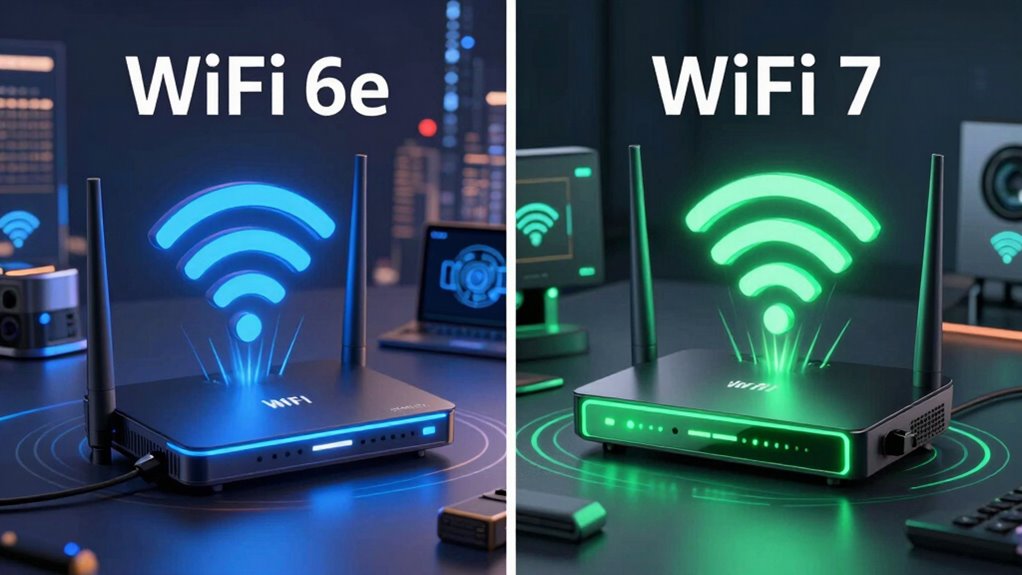
Wi-Fi 7 offers some impressive advancements that can greatly enhance your internet experience. You’ll enjoy faster speeds, lower latency, and more bandwidth options to accommodate all your devices. These improvements make it a game-changer for everything from streaming to gaming.
Enhanced Speed Capabilities
As technology evolves, the leap from Wi-Fi 6e to Wi-Fi 7 brings enhanced speed capabilities that can considerably improve your online experiences. With Wi-Fi advancements, you’ll benefit from impressive speed benchmarks that enable smoother streaming, faster downloads, and seamless gaming. Here’s what you can expect:
- Speeds up to 46 Gbps, considerably faster than Wi-Fi 6e
- Improved performance in dense environments, ideal for smart homes
- Enhanced data efficiency with Multi-Link Operation (MLO)
- Better support for high-bandwidth applications, like 8K streaming
- Greater coverage and reliability, reducing dead zones
These features promise a transformative experience, allowing you to maximize the potential of your devices and enjoy an uninterrupted online lifestyle.
Improved Latency Performance
With the remarkable speed enhancements of Wi-Fi 7, you’ll also notice a significant boost in latency performance. This improvement means less waiting and more doing, whether you’re gaming, streaming, or video conferencing. The technology behind Wi-Fi 7 focuses on latency reduction, ensuring quicker responses and overall performance optimization.
Here’s a quick comparison of latency performance:
| Feature | Wi-Fi 6e | Wi-Fi 7 |
|---|---|---|
| Average Latency (ms) | 20-30 ms | 10-20 ms |
| Multi-Device Performance | Moderate | Enhanced |
| Latency Reduction Techniques | Basic | Advanced |
With these advancements, you’ll enjoy a seamless experience, making Wi-Fi 7 the ideal choice for demanding applications. Embrace the future of connectivity!
Expanded Bandwidth Options
While you might be familiar with the benefits of previous Wi-Fi standards, Wi-Fi 7 takes expanded bandwidth options to a whole new level. It greatly enhances bandwidth allocation and spectrum utilization, allowing you to experience faster and more reliable connections. This means more devices can connect simultaneously without a hitch. Smart home connectivity continues to benefit from these advancements, supporting the growing number of connected devices in modern living spaces.
Here are some key features you can expect with Wi-Fi 7:
- Wider channel widths of up to 320 MHz
- Improved Multi-Link Operation for enhanced performance
- Higher data rates for streaming and gaming
- Advanced traffic management for smoother experiences
- Better performance in congested areas
With these innovations, you’ll enjoy a seamless online experience, whether you’re working from home or gaming with friends.
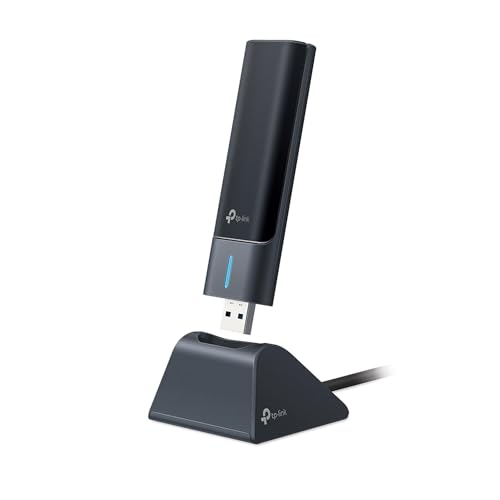
TP-Link WiFi 6E USB Adapter for Desktop PC – (Archer TXE50UH) AXE3000 Tri-Band Wireless Network Adapter, Ultra-Low Latency, MU-MIMO, OFDMA, Refined Security, WPA3, Supports Windows 11/10
𝟔𝐆𝐇𝐳 𝐖𝐢-𝐅𝐢 𝟔𝐄 – Maximized Performance – Experience more bandwidth, faster speed, and lower latency with WI-Fi 6E's…
As an affiliate, we earn on qualifying purchases.
As an affiliate, we earn on qualifying purchases.
Use Cases: Who Benefits Most From Wi-Fi 6E or Wi-Fi 7?
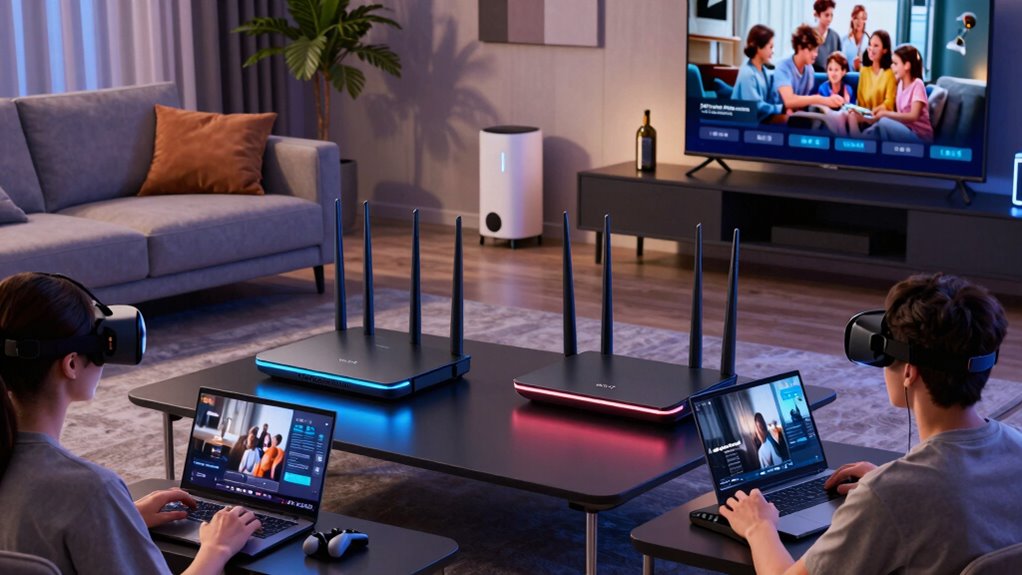
When it comes to choosing between Wi-Fi 6E and Wi-Fi 7, understanding who benefits most can help you make the right decision. Gaming enthusiasts will appreciate the lower latency of Wi-Fi 7, while smart home setups can take advantage of improved device connectivity. For businesses, the enhanced capacity and performance of Wi-Fi 7 can greatly boost productivity and efficiency.
Gaming Enthusiasts’ Advantage
As gaming technology evolves, the choice between Wi-Fi 6E and Wi-Fi 7 can profoundly impact your gaming experience. Opting for the right Wi-Fi standard can enhance your gaming performance and provide a competitive edge. Here’s how each option stands out:
- Lower latency for smoother gameplay
- Increased bandwidth to handle multiple devices
- Better support for high-resolution streaming
- Improved stability during intense gaming sessions
- Enhanced security features for safer online interactions
- The latest Wi-Fi standards incorporate AI-driven optimization techniques to adapt network performance in real-time, ensuring a more reliable gaming connection.
For serious gamers, Wi-Fi 7’s advancements may offer superior advantages, especially in fast-paced competitive environments. However, Wi-Fi 6E still delivers impressive performance that can satisfy most gaming needs. Choose wisely to elevate your gaming sessions!
Smart Home Integrations
Gamers aren’t the only ones who can benefit from the advancements of Wi-Fi 6E and Wi-Fi 7; smart home users are also set to gain substantially. With an increasing number of smart devices in your home, having a robust network becomes essential. Wi-Fi 6E and Wi-Fi 7 offer enhanced network compatibility, allowing you to connect more devices without sacrificing performance. Imagine seamless interactions between your smart thermostat, security cameras, and voice assistants, all operating flawlessly even during peak usage times. You’ll experience quicker response times, reduced latency, and improved reliability, making your smart home experience smoother than ever. If you want to enjoy the full potential of your smart devices, upgrading to Wi-Fi 6E or Wi-Fi 7 is a smart move, especially considering the increased device capacity that these standards provide. Additionally, these standards support advanced security protocols, safeguarding your connected home from potential cyber threats. As smart home ecosystems grow more complex, having a robust network infrastructure becomes increasingly important to ensure all devices work harmoniously. Upgrading your Wi-Fi can also future-proof your home for upcoming smart device innovations, ensuring compatibility with new technology advancements.
Business Connectivity Needs
Businesses today face increasing demands for reliable and high-speed connectivity, making Wi-Fi 6E and Wi-Fi 7 vital for various sectors. As you navigate this evolving landscape, consider how these technologies can enhance your business scalability and support your remote workforce. Incorporating smart programming into your network planning helps optimize performance and future-proof your infrastructure. Understanding wireless standards helps ensure you select the right technology for your needs. Staying informed about regulatory compliance ensures your network deployment adheres to industry requirements and best practices. Additionally, understanding network security protocols is essential for protecting sensitive business data in a wireless environment.
Here are some use cases where these technologies shine:
- High-density environments: Perfect for offices with many connected devices.
- Real-time collaboration: Facilitates seamless video conferencing and file sharing.
- IoT applications: Supports a growing number of smart devices in the workplace.
- Enhanced security: Provides better encryption and network management features.
- Future-proofing: Guarantees your business stays competitive as demands grow.

TP-Link Tri-Band BE11000 Wi-Fi 7 Gaming Router Archer GE650 | 6-Stream 11 Gbps supports 320MHz | 2×5G + 3×2.5G Ports USB 3.0 | Game Acceleration, Dedicated Gaming Port & Panel, RGB Lighting|HomeShield
𝐁𝐥𝐚𝐳𝐢𝐧𝐠-𝐅𝐚𝐬𝐭 𝐁𝐄𝟏𝟏𝟎𝟎𝟎 𝐓𝐫𝐢-𝐁𝐚𝐧𝐝 𝐖𝐢-𝐅𝐢 𝟕 – Achieve up to 5764 Mbps (6 GHz), up to 4320 Mbps (5…
As an affiliate, we earn on qualifying purchases.
As an affiliate, we earn on qualifying purchases.
Wi-Fi 6E vs. Wi-Fi 7: Speed and Performance Comparison
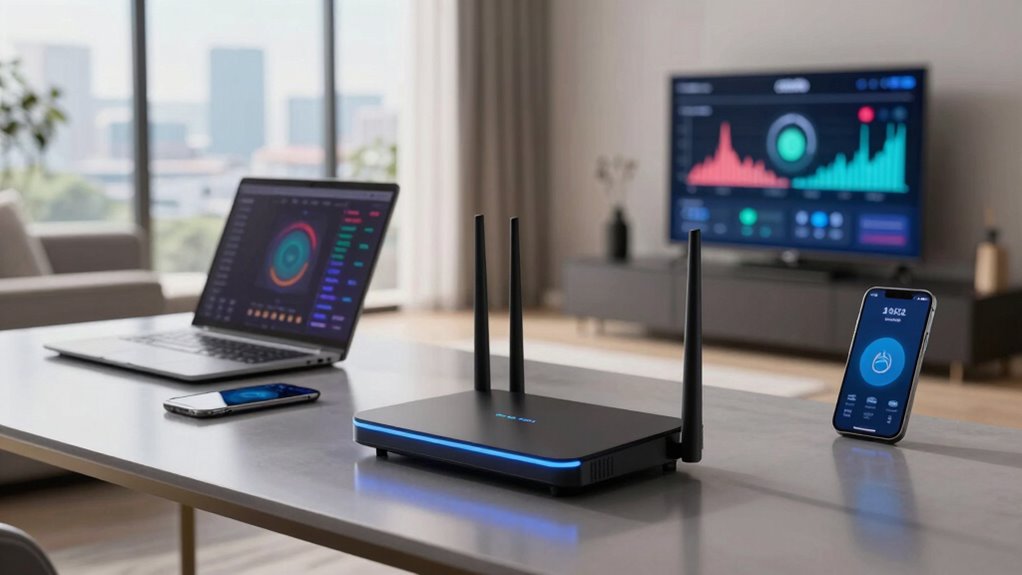
While many users enjoy the benefits of Wi-Fi 6E, the arrival of Wi-Fi 7 promises even greater speed and performance enhancements. With Wi-Fi 6E, you experience faster speeds and improved network compatibility thanks to the expanded 6GHz band. However, Wi-Fi 7 takes it a step further, offering multi-link operation, which allows devices to connect through multiple bands simultaneously. This means you’ll enjoy higher throughput and lower congestion, especially in busy environments. Additionally, Wi-Fi 7 can support more devices without compromising performance, making it ideal for households with numerous smart gadgets. As Wi-Fi standards evolve, you’ll want to reflect on your current and future needs to maximize your network’s efficiency and speed.
Which Standard Has Lower Latency and More Capacity?
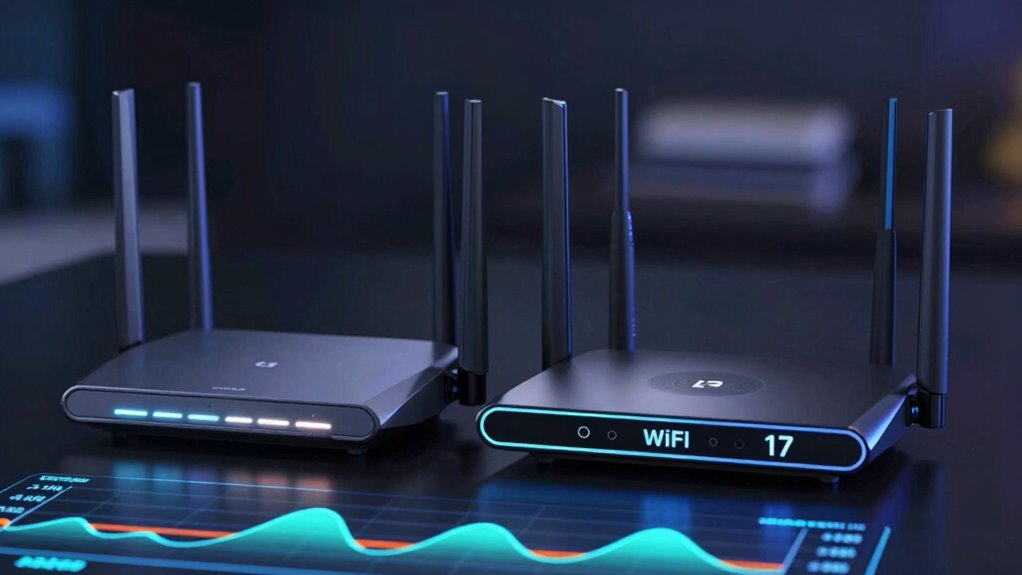
When it comes to latency and capacity, Wi-Fi 7 clearly outshines Wi-Fi 6E. In a latency comparison, Wi-Fi 7 offers reduced delays, making it ideal for activities that require quick responses, like online gaming or video conferencing. Additionally, capacity analysis reveals that Wi-Fi 7 can handle considerably more devices simultaneously, ensuring smoother connections even in crowded environments.
Wi-Fi 7 outperforms Wi-Fi 6E with lower latency and the ability to support more devices, enhancing connectivity in busy settings.
Here’s what you can expect from Wi-Fi 7:
- Lower latency for real-time applications
- Increased bandwidth availability
- Ability to support more simultaneous users
- Enhanced performance in dense areas
- Improved overall network efficiency
With these advancements, Wi-Fi 7 not only minimizes delays but also maximizes your network’s capacity, paving the way for a seamless experience across multiple devices.
Cost Considerations: Is Wi-Fi 7 Worth It?

Is Wi-Fi 7 worth the investment for your home or office? When considering the price comparison between Wi-Fi 6E and Wi-Fi 7, it’s important to evaluate your specific needs. While Wi-Fi 7 might carry a higher upfront cost, it could be a smart long-term investment. If you’re running multiple devices or require high-speed connections for streaming, gaming, or work, Wi-Fi 7’s enhanced capabilities may justify the expense. Consider how often you upgrade your tech; investing in Wi-Fi 7 could save you money in the long run by reducing the frequency of upgrades and ensuring faster, more reliable connectivity. Ultimately, weigh your current demands against future needs to see if Wi-Fi 7 fits your budget and lifestyle.
Future-Proofing Your Network With Wi-Fi 6E or Wi-Fi 7
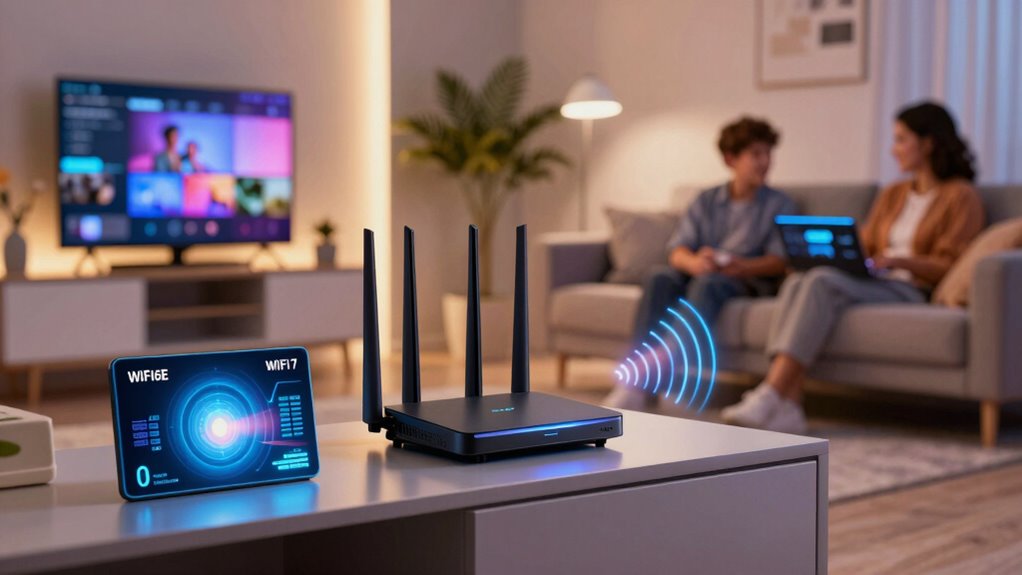
As technology evolves, guaranteeing your network can keep pace is essential for both home and office environments. Investing in Wi-Fi 6E or Wi-Fi 7 can enhance your network longevity and future-proof your setup. By choosing one of these standards, you’re making a smart technology investment that can support your increasing connectivity needs.
- Increased bandwidth for multiple devices
- Lower latency for smoother streaming and gaming
- Enhanced performance in crowded spaces
- Future compatibility with emerging tech
- Improved security features
Embracing Wi-Fi 6E or Wi-Fi 7 now means you won’t have to worry about your network becoming outdated anytime soon. This proactive approach guarantees your setup remains efficient and capable of handling tomorrow’s demands, especially as off-road gear technology continues to advance and require more reliable connectivity. Additionally, these standards incorporate advanced interference mitigation, ensuring consistent performance even in complex environments. Incorporating future-proofing strategies can further extend the lifespan of your network investment and adapt to rapid technological changes. For instance, network scalability is vital to accommodate future upgrades seamlessly, and understanding the latest wireless standards can help you make more informed decisions.
Frequently Asked Questions
How Do Wi-Fi 6E and Wi-Fi 7 Impact Battery Life for Devices?
Wi-Fi 6e and Wi-Fi 7 both improve battery life for your devices through better battery optimization and increased device efficiency. They allow your devices to maintain strong connections with less power consumption, which means you can enjoy longer usage times. Wi-Fi 7’s advancements, such as improved data handling, further enhance this efficiency, ultimately reducing the energy your devices use while staying connected, making it easier for you to stay online without constantly recharging.
Are There Compatibility Issues Between Wi-Fi 6E and Older Devices?
Yes, there can be compatibility issues between Wi-Fi 6e and older devices. While Wi-Fi 6e offers backward compatibility, older devices may not fully utilize the advanced features, which can impact their performance. Think of it like a classic car struggling to keep pace on a modern highway; it’ll work, but it won’t shine. You’ll likely experience slower speeds or limited functionalities if you mix old and new tech, so consider your devices carefully.
Will Wi-Fi 7 Improve Online Gaming Experiences Significantly?
Yes, Wi-Fi 7’s advancements can greatly improve your online gaming experience. You’ll notice reduced latency, which means faster response times during gameplay. The increased gaming bandwidth allows for smoother connections, even when multiple devices are online. This means fewer interruptions and a more enjoyable gaming session. As you upgrade to a Wi-Fi 7 router, you’ll likely see enhancements that keep you competitive and immersed in your favorite games.
How Does Network Congestion Affect Wi-Fi 6E and Wi-Fi 7 Performance?
When it comes to network performance, a smooth ride can quickly turn bumpy due to network congestion. Wi-Fi 6e offers decent congestion management, but Wi-Fi 7 takes it up a notch with advanced features that better handle crowded environments. You’ll notice improved speed and reliability, especially during peak usage times. So, if you’re often battling slow connections, choosing Wi-Fi 7 might just save the day for your online activities.
Can I Mix Wi-Fi 6E and Wi-Fi 7 Devices on the Same Network?
Yes, you can mix Wi-Fi 6e and Wi-Fi 7 devices on the same network. These devices are designed for compatibility, allowing them to communicate effectively even with different standards in play. You’ll benefit from the advanced features of both technologies, but remember that the overall performance might depend on your router and the specific devices’ capabilities. Just confirm your router supports mixed networks to optimize your experience!
Conclusion
In the debate between Wi-Fi 6E and Wi-Fi 7, it’s clear that both offer distinct advantages depending on your needs. If you’re craving faster speeds and lower latency for gaming or streaming, Wi-Fi 7 might be the better choice. But if you’re looking for a solid upgrade without breaking the bank, Wi-Fi 6E still delivers impressive performance. So, are you ready to future-proof your network, or will you stick with what you have for now?