
TL;DR

Get the little things that make your day delivered free — and shop member deals
- Fast, free delivery on millions of items
- Access to Prime Big Deal Days deals on October 6–7
- Prime Video, Amazon Music and more included
Building your own AI workstation used to be cheaper, but in 2026, prebuilt options often match or beat DIY prices thanks to component shortages and bulk buying. The real decision now hinges on how much control, speed, and support you want versus the effort of tuning your system yourself.
Imagine powering up your AI project — but instead of spending months sourcing parts, assembling, and fine-tuning, you hit a button and everything works. Sounds like the dream, right? But is it worth paying extra for that convenience? Or does building your own still hold the edge?
This choice has become more complex in 2026. The old rule — build cheaper, buy faster — no longer always applies. With chip shortages and bulk buying driving up DIY costs, your decision now depends on more than just dollars. It’s about speed, control, and whether you’re willing to get your hands dirty or prefer a proven, supported system. For more insights, visit our homepage to explore related home and tech solutions.
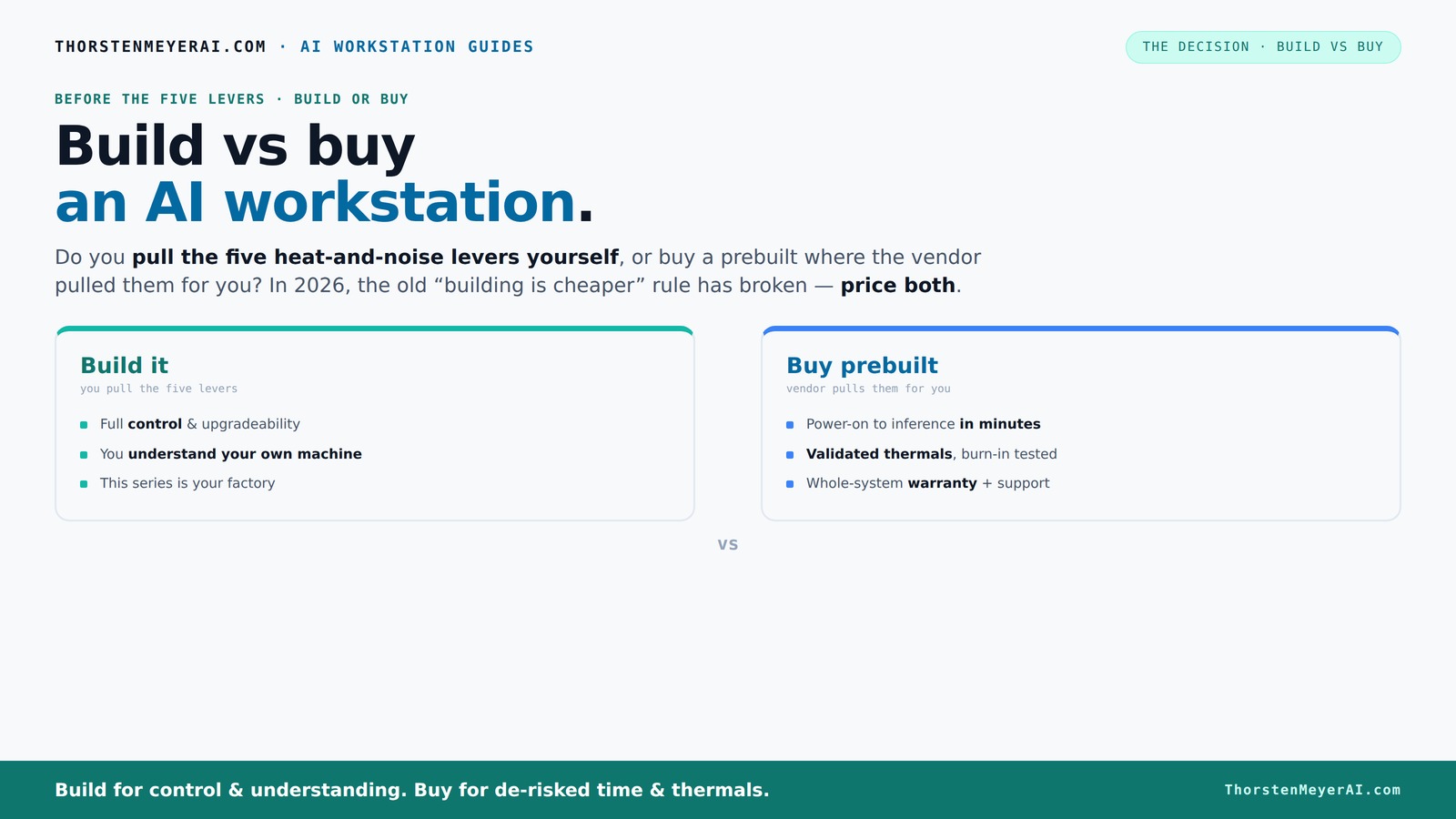
Build vs buy
an AI workstation.
The real question behind this whole series: do you pull the five heat-and-noise levers yourself, or buy a prebuilt where the vendor pulled them for you? And in 2026, the old “building is cheaper” rule has broken. Match your situation in Part 3.
Key Takeaways
- Component shortages in 2026 have pushed DIY build costs upward, sometimes surpassing prebuilt prices.
- Prebuilt workstations often include validated thermals and a warranty, reducing risk and setup time.
- Building offers maximum customization and learning but requires time, skills, and ongoing maintenance.
- In high-end AI setups, vendor-validated cooling and power delivery often justify the cost of prebuilt systems.
- Future-proofing depends on your willingness to upgrade — builds generally offer more flexibility, but check vendor options.
As an affiliate, we earn on qualifying purchases.
Why Building Your Own AI Workstation Is No Longer Cheaper (Spoiler: It’s Not)
Building your own AI workstation used to be the clear cost-cutting move. You’d buy parts separately, assemble, and save a few hundred dollars. But in 2026, that’s changed. The global chip crunch and component shortages have pushed prices sky-high. A GPU that used to cost $900 now hits $1,200 or more.
Moreover, the implications of these rising costs extend beyond just the initial purchase. Higher component prices mean that DIY builders face increased financial risk, especially if they need to replace parts or upgrade down the line. The supply chain disruptions also lead to longer wait times, which can stall your project. On the other hand, prebuilt vendors, having bought in bulk early and optimized their manufacturing, often offer systems at prices matching or even lower than DIY. Some systems come with validated thermals, warranty, and support, all baked into the price. This shift underscores how market dynamics—like shortages and bulk purchasing—favor ready-made solutions, especially when considering the total cost of ownership and time investment. It’s no longer just about sticker price but about the real cost—time, risk, and reliability.
As an affiliate, we earn on qualifying purchases.
The Real Question: Will You Pull the Levers or Pay Someone Else to Do It?
High-power AI workstations are like furnaces — they generate heat, noise, and demand careful tuning. The five levers? Undervolt the GPU, match the cooler, optimize airflow, tune fans, and place the system for best cooling.
When you buy a prebuilt, the vendor pulls these levers for you — validating thermals, tuning fan curves, sometimes adding water cooling for quieter operation. These systems are tested to run under sustained load without throttling, often with a warranty backing up the promise. This process reduces the guesswork and trial-and-error that can be time-consuming and potentially damaging if not done correctly, especially for those unfamiliar with thermal management. It also means your system is optimized for stability and longevity, which can directly impact your productivity and hardware lifespan.
Build it yourself? You’re in charge. You select a quiet GPU, undervolt it with software like [this](https://thorstenmeyerai.com/undervolt-gpu-local-inference/), pick a case with good airflow, and tune everything manually. This approach allows for maximum customization—tailoring cooling and acoustics precisely to your needs. However, it also involves a steep learning curve, trial-and-error, and the risk of misconfiguration, which can lead to thermal throttling, hardware instability, or noise issues that diminish your system’s performance and durability. The core tradeoff is control versus convenience. Do you prefer the peace of mind and efficiency of vendor-validated tuning, or the satisfaction and potential performance gains of DIY tuning? Understanding these implications helps you decide where to invest your time and effort.
As an affiliate, we earn on qualifying purchases.
When Buying a Prebuilt Makes Sense (And When It Doesn’t)
If your main goal is immediate productivity, buying a prebuilt often wins. You get a system ready to run with CUDA, PyTorch, or TensorFlow installed — no fuss, no setup time. For busy professionals, that can mean days or weeks shaved off deployment time. This immediate availability allows you to start your work sooner, reducing project delays and enabling faster iteration cycles. Additionally, prebuilt systems are often tested under real workloads, ensuring stability and performance consistency, which minimizes troubleshooting and downtime. This reliability can be crucial when deadlines are tight or when your expertise in hardware tuning is limited.
Plus, a reputable vendor tests the system under stress, confirms it won’t throttle during intense workloads, and offers support if something goes wrong. Systems from companies like Lambda or Puget are built for multi-GPU setups, with validated cooling and power delivery. This thorough testing and support infrastructure can save you significant time and reduce the risk of costly mistakes, especially if your project depends on stable and predictable hardware performance.
However, if you crave total control, love tinkering, or want to push the limits with custom cooling or unconventional hardware, building is still your playground. Just be ready for more time, effort, and troubleshooting. The tradeoff here is between convenience and customization—if your project benefits from fine-tuning or experimental setups, building might be the better choice despite the initial effort.
In 2026, consider buying if speed and support are your priorities — especially for high-end, multi-GPU rigs where thermal management becomes a science. This approach minimizes risk and maximizes uptime, which can be decisive for critical projects.
As an affiliate, we earn on qualifying purchases.
Build It Yourself: When and Why It’s Still Worth It
If you’re a hobbyist, student, or someone who loves hardware, building your own AI workstation remains appealing. It’s about customization, learning, and squeezing out every ounce of performance. This approach allows you to select components tailored precisely to your workload and preferences, which can lead to better efficiency and cost-effectiveness in the long run. For example, choosing a high-core CPU paired with a GPU optimized for your specific AI tasks can yield performance gains that prebuilt systems might not offer out of the box. Additionally, the process of building can deepen your understanding of hardware interactions, thermal dynamics, and system tuning, empowering you to troubleshoot and upgrade more effectively over time.
Source your parts from trusted suppliers, and consider consulting guides on building.ike [Amazon](https://www.amazon.com/dp/?tag=dreamridiculo-20), and pick components based on your specific needs — a quiet GPU, a high-core CPU, ample RAM, fast NVMe drives. You control each detail, which can be especially valuable if you have unique space, noise, or power constraints. Plus, building your own system can be incredibly satisfying, giving you a sense of ownership and mastery that prebuilt solutions can’t match.
However, this path requires time, patience, and some technical skill. If you’re short on these or prefer to focus solely on your AI work rather than hardware, a prebuilt might be more practical. But if you enjoy hardware tinkering and want a system perfectly tuned to your preferences, building remains a compelling option.
Upgrade Paths & Future-Proofing: Can You Keep Your System Fresh?
Upgrading a prebuilt can be tricky. Many systems have proprietary cases, limited space, or power supplies that don’t support future GPUs or additional RAM. This can lock you into a specific configuration, making future upgrades costly or impossible without replacing the entire system. These limitations can hinder your ability to adapt to evolving AI workloads or incorporate new hardware advances, which might slow your progress or require additional capital expenditure sooner than expected. Therefore, when considering a prebuilt, it’s crucial to evaluate its upgradeability—look for modular designs, open standards, and easily accessible components that support future expansion.
Custom builds often have more room to grow. You can swap out GPUs, add RAM, or upgrade storage without much hassle, providing a flexible platform that can evolve with your needs. This long-term adaptability can be especially valuable if you plan to keep your AI workstation for several years or anticipate significant workload growth. However, some vendor systems now also offer modular designs that support upgrades — just check the specs and ask about future expansion options. The key is balancing current needs with anticipated future requirements, ensuring your investment remains relevant and capable over time.
In 2026, if you plan to keep your AI workstation for years, a build might give you better long-term flexibility. Just weigh that against the initial effort required and the potential limitations of prebuilt systems. The ability to upgrade can significantly extend the lifespan and value of your investment, especially as hardware and AI models evolve rapidly.
Support, Warranty, and Peace of Mind — Why It Matters
Prebuilt vendors include support, warranty, and often on-site servicing. If your system fails during a critical AI training run, you have someone to call. Systems from Lambda or Puget come with up to 5-year warranties on parts and labor. This support infrastructure reduces downtime risk and provides peace of mind, especially important when dealing with complex hardware that may require troubleshooting or repairs. The ability to quickly get expert help can save days or weeks of productivity, preventing costly delays and project setbacks. Additionally, support services often include proactive diagnostics, firmware updates, and troubleshooting assistance, which help maintain system stability over time.
Building your own? You’re on your own. Troubleshooting hardware compatibility, thermal issues, or driver conflicts falls on your shoulders. Unless you buy extended support or warranties yourself, this increases your risk of unexpected downtime and the associated costs. In high-stakes AI projects where time is critical, the assurance of vendor support can justify a higher initial cost, as it safeguards your productivity and reduces risk.
Ultimately, support and warranty considerations are about risk management. They can be the deciding factor if your project’s success hinges on system reliability and uptime, especially when hardware failures could cause significant setbacks.
The Final Call: Which Path Fits Your Needs?
The decision isn’t just about dollars. It’s about how much control, speed, and security matter to you. In 2026, prebuilt systems often match or beat DIY costs thanks to market shifts, but the choice depends on your priorities.
If you value plug-and-play, support, and quick deployment, buy a prebuilt. If you love tuning, customizing, and learning, building is still a rewarding journey — just expect more time and effort. Consider your timeline, technical skills, and whether your project demands the utmost control or just raw performance. Whichever you choose, stay curious and keep testing — your perfect AI workstation is out there.
Frequently Asked Questions
Is it cheaper to build or buy a prebuilt AI workstation?
In 2026, component shortages have driven up DIY costs, often making prebuilt systems equally or more affordable. Always compare current prices before deciding.How fast can I get a prebuilt AI workstation up and running?
Prebuilt systems usually arrive ready to use, with software preinstalled. Expect deployment in a few days to a week, versus weeks or months for a DIY build.What specs matter most for AI workloads?
GPU VRAM, CPU cores, RAM capacity, and fast NVMe storage are critical. For large models or fine-tuning, a GPU with at least 24GB VRAM and a high-core CPU make a difference.Can a prebuilt handle training or only inference?
High-quality prebuilt workstations are designed for both. Look for robust cooling and power delivery for multi-GPU training or intensive inference tasks.How upgradeable are prebuilt AI workstations?
It varies. Many have limited room for expansion, but some vendors design systems with future upgrades in mind. Always check the specifications before buying.Conclusion
In 2026, the choice between build and buy is less about saving money and more about what you value most: speed, support, or control. The market has shifted, making prebuilt systems often as affordable as DIY — sometimes even more so.
So, ask yourself: do you want a ready-to-go machine with support, or the satisfaction of building and tuning your own? Either way, your AI adventure is just beginning, and your perfect rig is within reach.
NFL season / tailgating Picks
team gear
As an affiliate, we earn on qualifying purchases.