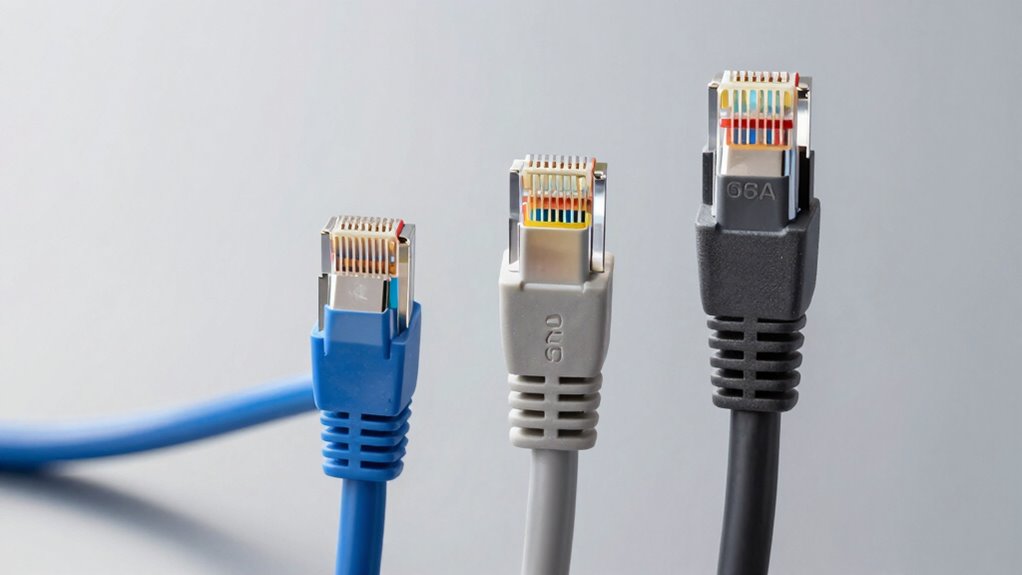

When choosing Ethernet cables, you’ll find different categories like Cat5e, Cat6, and Cat6a, each offering unique benefits. Cat5e supports up to 1 Gbps and is great for basic needs. Cat6 boosts speeds to 10 Gbps over short distances, perfect for gaming. Cat6a maintains those speeds over longer distances, making it ideal for bandwidth-heavy applications. Selecting the right one can enhance your network’s reliability and performance, and there’s more to explore about each category’s features and use cases.

Get the little things that make your day delivered free with Prime
- Fast, free delivery on millions of items
- Prime Video, Amazon Music and more included
- Member-only deals all year
Key Takeaways
- Cat5e supports speeds up to 1 Gbps and is ideal for basic home networking and streaming applications.
- Cat6 offers speeds up to 10 Gbps over short distances, suitable for gaming and large file transfers.
- Cat6a maintains 10 Gbps speeds over longer distances and is designed for bandwidth-intensive applications like video conferencing.
- All categories support a maximum distance of 100 meters, but higher categories provide better performance and reduced crosstalk.
- Future-proofing with Cat6a is beneficial for businesses, ensuring adaptability to emerging technologies and increasing data loads.
As an affiliate, we earn on qualifying purchases.
Understanding Ethernet Cable Categories
When you look at Ethernet cables, it’s essential to understand the different categories, as they directly impact your network’s performance. Ethernet standards define how data is transmitted over these cables, with each category offering varying speeds and bandwidth capabilities. For instance, higher categories like Cat6 and Cat6a support faster speeds and better shielding, which minimizes interference. Cable shielding is particularly important in environments with high electromagnetic interference, as it protects your signal quality. By choosing the right category, you can guarantee that your network runs efficiently, whether you’re streaming, gaming, or handling large data transfers. So take the time to assess your needs and select the appropriate Ethernet cable for ideal results.
As an affiliate, we earn on qualifying purchases.
Key Features of Cat5e?
Cat5e cables are a popular choice for many home and office networks due to their balance of performance and cost. These cables support speeds up to 1 Gbps and frequencies up to 100 MHz, making them suitable for various applications. You’ll find that the cat5e specifications allow for reduced crosstalk, which enhances signal quality and reliability. This makes them ideal for everyday tasks like web browsing, streaming, and online gaming. Additionally, cat5e applications extend to VoIP phones and security cameras, providing a versatile solution for your networking needs. With their affordability and solid performance, cat5e cables remain a go-to option for users looking to establish reliable connections without breaking the bank.
High-speed Ethernet cable for gaming
As an affiliate, we earn on qualifying purchases.
As an affiliate, we earn on qualifying purchases.
Advantages of Cat6 Cables
One of the standout advantages of Cat6 cables is their ability to support higher data rates, reaching up to 10 Gbps over shorter distances. This makes them ideal for high-bandwidth applications like online gaming, streaming, and large file transfers. When you choose Cat6 for your network, you’ll benefit from reduced crosstalk and better overall performance compared to lower category cables. Plus, Cat6 installation is straightforward, allowing you to upgrade your network without a lot of hassle. Although cat6 pricing may be slightly higher than Cat5e, the enhanced speed and performance justify the investment, especially for future-proofing your home or office network. Ultimately, Cat6 cables offer a solid balance of performance and affordability.
Long-distance Cat6a Ethernet cable
As an affiliate, we earn on qualifying purchases.
As an affiliate, we earn on qualifying purchases.
Benefits of Cat6a for Ultra-Fast Networks
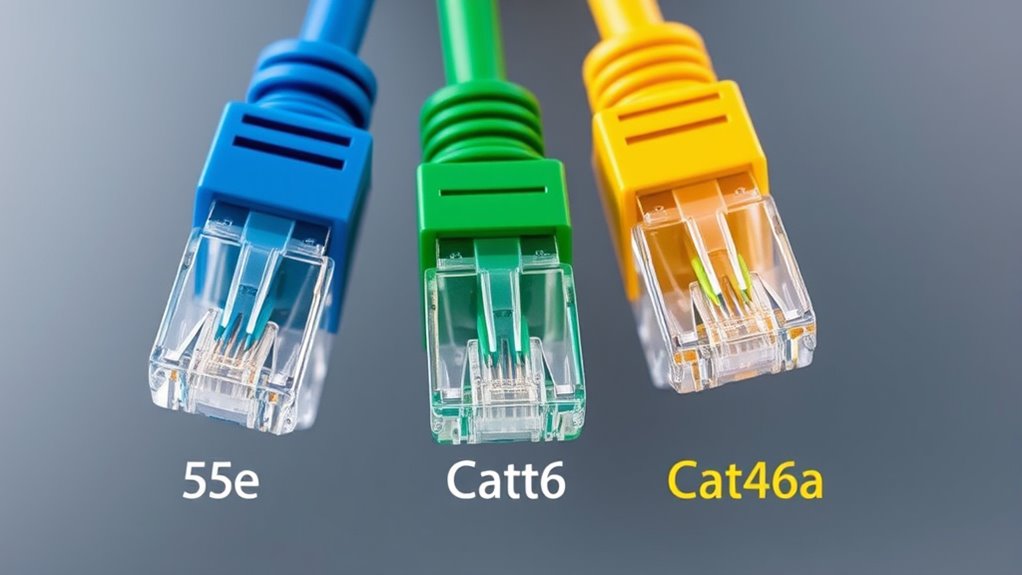
Building on the advantages of Cat6 cables, Cat6a takes performance to the next level, making it an excellent choice for ultra-fast networks. One of the primary cat6a advantages is its ability to support higher frequencies, reaching up to 500 MHz. This increased frequency allows for faster data transmission and improved overall network speed, which is vital for bandwidth-intensive applications like gaming, streaming, and video conferencing. Additionally, Cat6a cables reduce crosstalk and interference, ensuring a more reliable connection. With a maximum data rate of 10 Gbps over longer distances, you won’t have to worry about lag or dropouts. If you’re looking to future-proof your network, investing in Cat6a is a smart choice that can enhance your online experience considerably. Ethernet cable standards continue to evolve, providing even greater performance options for demanding environments.
Ethernet Cable Bandwidth Comparison: Cat5e, Cat6, Cat6a
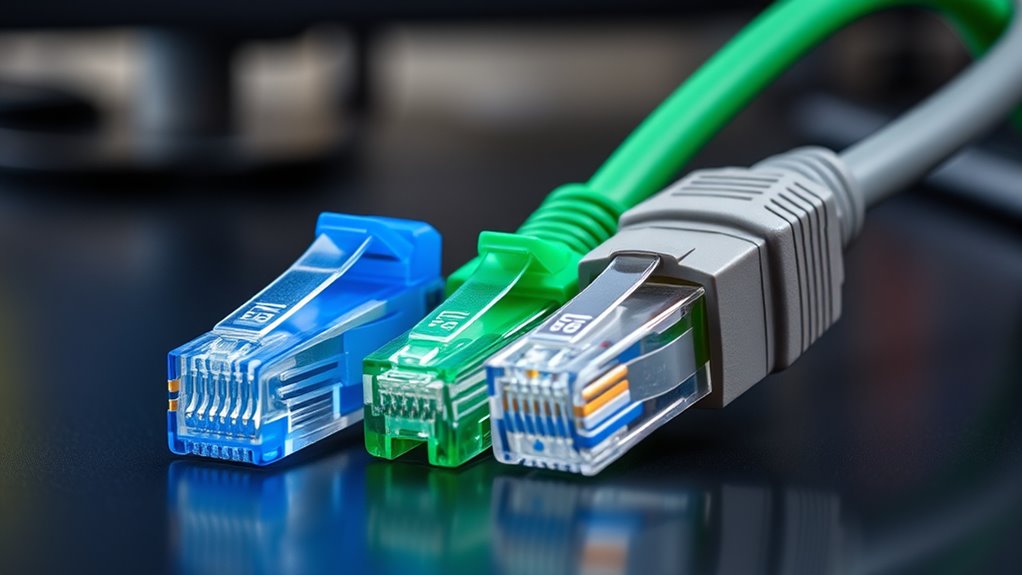
When choosing between Cat5e, Cat6, and Cat6a cables, it’s important to understand their bandwidth capabilities and frequency ranges. Each category offers different performance levels, especially over distances. You’ll want to take these factors into account to guarantee you select the best cable for your network needs.
Maximum Bandwidth Capabilities
As you explore the various Ethernet cable categories, understanding their maximum bandwidth capabilities can help you choose the right option for your needs. Each category meets different speed requirements and has distinct bandwidth limitations.
| Ethernet Cable | Maximum Bandwidth |
|---|---|
| Cat5e | 100 MHz |
| Cat6 | 250 MHz |
| Cat6a | 500 MHz |
While Cat5e supports up to 1 Gbps, it may struggle with higher speed demands. Cat6 enhances this with support for faster speeds, ideal for modern applications. For even greater performance, Cat6a doubles the bandwidth, making it suitable for data-intensive tasks. Choose wisely based on your bandwidth needs to guarantee peak performance.
Frequency Range Differences
While you may be familiar with the maximum bandwidth capabilities of different Ethernet cables, the frequency range differences between Cat5e, Cat6, and Cat6a are equally important to understand. Cat5e operates at up to 100 MHz, which suffices for basic networking needs. In contrast, Cat6 offers a frequency range comparison of up to 250 MHz, enhancing signal integrity and reducing interference. Cat6a takes it a step further, supporting frequencies up to 500 MHz, making it ideal for high-demand applications like 10 Gigabit Ethernet. This increased frequency range not only boosts performance but also guarantees that the signal remains clear over longer distances. Knowing these differences helps you choose the right cable for your specific networking requirements.
Performance Over Distance
Understanding how Ethernet cables perform over distance is crucial for maximizing your network. Each cable category—Cat5e, Cat6, and Cat6a—has specific distance limitations that affect signal integrity. Cat5e supports up to 100 meters at speeds of 1 Gbps, but as you push that limit, you may experience signal degradation. Cat6 can also reach 100 meters, but it offers better performance at 10 Gbps for shorter distances (up to 55 meters). If you need extended distances without compromising speed, Cat6a is your best bet, maintaining 10 Gbps up to 100 meters while minimizing interference. Choosing the right cable based on performance over distance guarantees you maintain strong connectivity and peak network efficiency.
Maximum Distances Supported by Ethernet Cable Categories
When choosing an Ethernet cable, understanding the maximum distances each category supports is essential for your network’s performance. Cat5e typically supports up to 100 meters, while Cat6 can also reach 100 meters but with better performance at higher speeds. Cat6a, on the other hand, maintains that distance while offering enhanced shielding for even better signal integrity.
Cat5e Maximum Distance
If you’re setting up a network, knowing the maximum distance for Cat5e cables is essential for maintaining ideal performance. Cat5e cables can effectively transmit data up to 100 meters (about 328 feet) without compromising cable performance. Beyond this distance, signal degradation occurs, which can lead to slower speeds and connectivity issues. To guarantee peak performance, consider implementing installation tips like using shorter runs when possible and avoiding sharp bends in the cable. Additionally, make sure that your connections are secure to minimize interference. By keeping these factors in mind, you can maximize the efficiency of your Cat5e setup and maintain a reliable network for your devices.
Cat6 Maximum Distance
After exploring the maximum distance for Cat5e cables, it’s time to look at Cat6 cables and their capabilities. Cat6 cables support a maximum distance of 100 meters (328 feet) for 10 Gbps speeds over short runs. For 1 Gbps connections, you can run them up to 100 meters as well. When planning your installation, consider the following table for a quick overview:
| Distance (m) | Speed (Gbps) | Application |
|---|---|---|
| 100 | 10 | Data Centers |
| 100 | 1 | Office Networks |
| 55 | 10 | High-performance |
For peak performance, remember these cat6 installation tips and keep in mind the cat6 applications overview to guarantee you maximize your network’s potential.
Cat6a Maximum Distance
While Cat6 cables are impressive, Cat6a takes performance a step further with its maximum distance capabilities. You can enjoy greater flexibility in your networking setup, as Cat6a supports distances up to 100 meters for 10 Gbps speeds. This makes it ideal for various cat6a applications, such as data centers and high-speed networks.
When considering Cat6a installation, keep these points in mind:
- Supports 10 Gbps over 100 meters
- Better crosstalk performance than Cat6
- Suitable for high-bandwidth applications
- Future-proofing for upcoming technologies
With Cat6a, you’re ensuring your network remains robust and efficient, even as demands increase. So, if you’re planning an upgrade, Cat6a’s maximum distance capabilities are a strong reason to make the switch.
Use Cases: Choosing Between Cat5e, Cat6, and Cat6a
When choosing between Cat5e, Cat6, and Cat6a Ethernet cables, it’s crucial to evaluate your specific needs and environment. Each cable has distinct use cases based on installation scenarios. For basic home networking, Cat5e often meets performance requirements without breaking the bank. However, if you’re streaming HD video or gaming, Cat6 offers higher speeds and better interference resistance. For businesses or future-proofing, Cat6a is ideal, providing enhanced performance for demanding applications. Consider your budget as well; while Cat6a may seem pricier, it can save you money in the long run by reducing the need for upgrades. Ultimately, align your choice with your current and anticipated needs to guarantee peak connectivity.
Future-Proofing Your Network: Selecting the Right Ethernet Cable
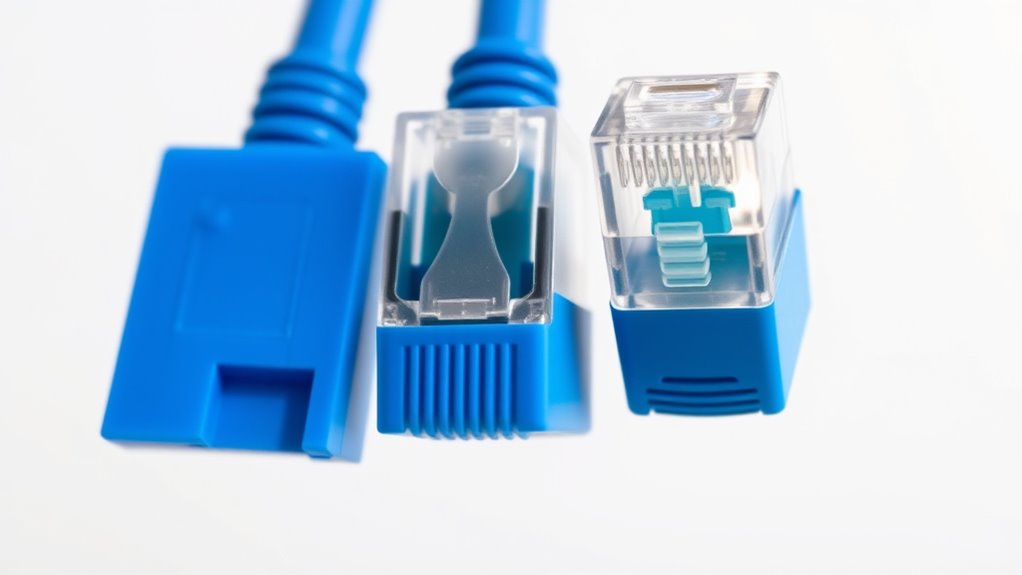
As technology evolves, you need to reflect on future-proofing your network by selecting the right Ethernet cable. Choosing the right cable today can save you from frequent upgrades tomorrow. Here are some key points to contemplate for network scalability options and future network upgrades:
- Bandwidth Requirements: Assess your current and anticipated bandwidth needs.
- Distance Limitations: Reflect on the distance between your devices; longer runs might necessitate higher categories.
- Compatibility: Verify your cables are compatible with existing network equipment.
- Future Technologies: Think about emerging technologies that may require higher speeds or more robust connections.
- Understanding Data Transmission Standards: Familiarizing yourself with data transmission standards can help you choose cables that support upcoming network demands.
- Scalability and Upgradability: Considering scalability options now ensures your network can adapt to future increases in data load without complete overhauls.
- Installation and Maintenance: Proper installation and ongoing maintenance best practices can extend the lifespan and performance of your network infrastructure.
Frequently Asked Questions
Can I Use Cat6 Cables With Cat5e Equipment?
Yes, you can use Cat6 cables with Cat5e equipment. The Cat6 cable will maintain its performance and provide better network stability, even if it’s connected to older equipment. However, the overall speed and performance will still be limited by the Cat5e devices. So, while upgrading to Cat6 is a good idea for future-proofing your network, you won’t experience the full benefits until you upgrade your equipment as well.
How Do Ethernet Cables Affect Internet Speed?
Oh sure, just plug in a spaghetti noodle and expect your internet speed to skyrocket, right? Ethernet cables play a vital role in your internet performance factors. If you’re using a longer cable, it can slow down the speed due to signal degradation. So, while your cat might be more interested in the cable itself, you should stick to high-quality cables to keep your connection speedy and reliable.
What Is the Difference in Pricing Between Cat5e, Cat6, and Cat6a?
Cat5e pricing is generally the most budget-friendly option, making it perfect for basic networking needs. On the other hand, Cat6 cables are slightly more expensive due to their enhanced performance capabilities. When you look at Cat6a features, which support higher speeds and longer distances, you’ll notice a noticeable jump in price. So, if you’re aiming for superior performance and future-proofing, investing in Cat6a might be worth the extra cost.
Are There Any Compatibility Issues With Older Devices?
You won’t face many compatibility issues with older devices when using newer Ethernet cables. Most modern cables are backward compatible, allowing them to work with older hardware. However, using a high-performance cable like Cat6a might not enhance the performance of older devices that can’t support faster speeds. So, while your older devices will connect fine, their performance won’t improve much beyond what they’re designed for. Just keep that in mind!
Do Ethernet Cables Degrade Over Time?
Yes, Ethernet cables can degrade over time, impacting their lifespan and signal quality. Factors like temperature, humidity, and physical wear can cause deterioration. If you notice slower internet speeds or intermittent connections, it might be time to check your cables. Regularly inspecting and replacing old or damaged cables can help maintain peak performance. By staying proactive, you’ll guarantee that your network runs smoothly and efficiently.
Conclusion
When it comes to choosing the right Ethernet cable, you really can’t go wrong with understanding your needs. Cat5e is great for basic tasks, while Cat6 offers a solid upgrade for speed and performance. If you’re aiming for ultra-fast networks, Cat6a is the way to go. In the end, picking the right cable is like choosing the right tool for the job—it makes all the difference. So, invest wisely and keep your network future-proof!
NFL season / tailgating Picks
team gear
As an affiliate, we earn on qualifying purchases.