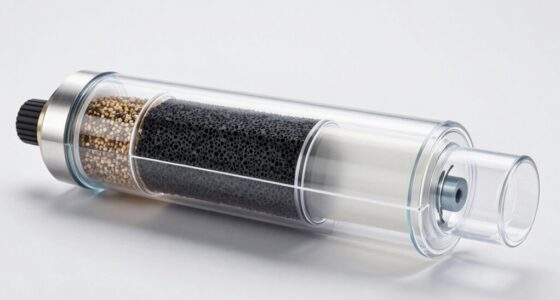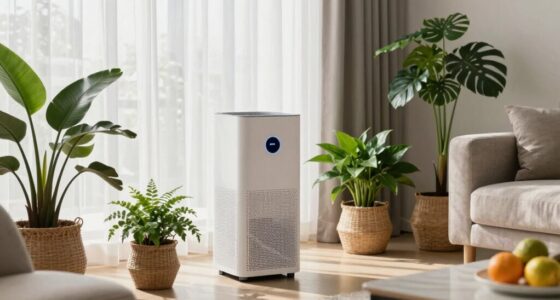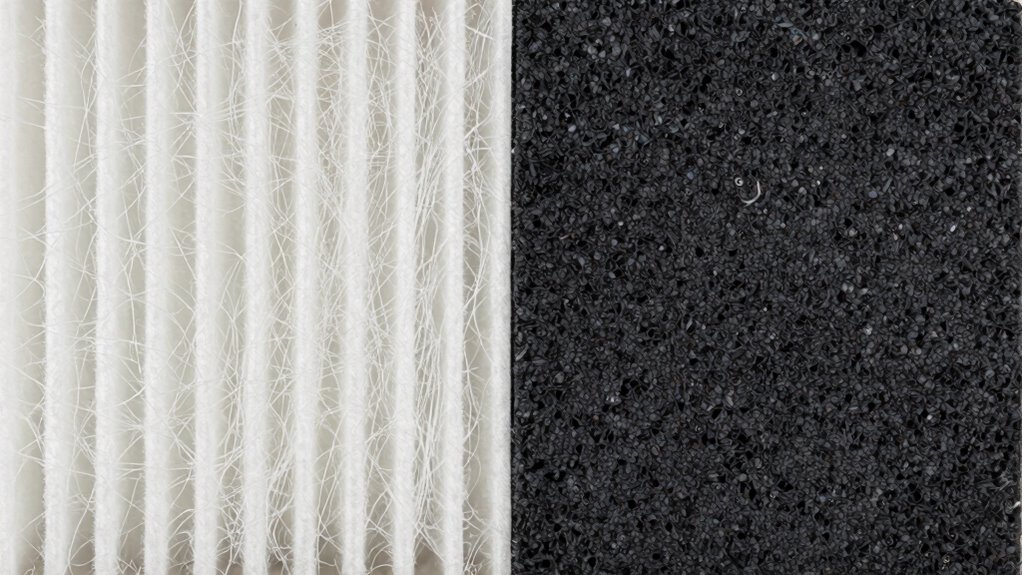

HEPA filters target tiny airborne particles like allergens, dust, and viruses by physically trapping them, making them ideal for allergy sufferers. Carbon filters, on the other hand, absorb odors and chemical fumes through adsorption, perfect for removing smells from kitchens or smoking areas. Choosing between them depends on your needs—air quality or odor control. Want to know how each works best and how to optimize their performance? Keep exploring to find out more.
Key Takeaways
- HEPA filters trap tiny airborne particles, including allergens and viruses, while carbon filters primarily remove odors and chemical fumes.
- HEPA uses physical fiber structures for particle capture; carbon relies on porous surfaces to adsorb gases and odors.
- HEPA filters are suitable for allergy-prone environments, whereas carbon filters excel in odor and VOC removal.
- HEPA filters generally last longer (6-12 months) but tend to be more expensive; carbon filters need frequent replacement (1-3 months).
- Combining both filters provides comprehensive air purification by targeting particles and gaseous pollutants simultaneously.

LEVOIT Air Purifier for Home Allergies and Pets Hair Smokers in Bedroom, H13 True HEPA Filter, 24db Filtration System Cleaner Odor Eliminators, Remove 99.97% Dust Smoke Mold Pollen, Core 300, White
- AHAM Verified for Performance: Independently tested for air quality and efficiency
- Powerful Filtration System: 56W motor with 143 CFM CADR
- Effective for Multiple Pollutants: Removes dust, smoke, mold, pollen
As an affiliate, we earn on qualifying purchases.
As an affiliate, we earn on qualifying purchases.
Which Air Filter Is Best for Allergies and Odors?

When it comes to tackling allergies and odors, choosing the right air filter makes a big difference. To improve air quality, you need a filter that effectively captures airborne allergens like pollen, dust, and pet dander, as well as neutralizes odors. HEPA filters excel in filter efficiency for allergy sufferers, trapping tiny particles that trigger reactions. They create cleaner, healthier indoor air, making breathing easier. Carbon filters, on the other hand, are better at absorbing odors and chemical fumes, but they don’t remove allergens as effectively. For *ideal* air quality, many people combine both types. If your main concern is allergies, prioritize a high-efficiency HEPA filter. If odors are your primary issue, a carbon filter will help reduce smells and chemical pollutants. Additionally, understanding the diverse urban activities in regions like Harrisburg can help you choose air purifiers suited for busy environments with higher pollution levels.

ShuRex 4 Pack Activated Charcoal Odor Absorbing Filter Refill Deodorizer
- Compatibility: Fits iTouchless 8 Gal and larger trash cans
- Odor Control: Absorbs and neutralizes trash odors
- Size: 3" W x 5" L
As an affiliate, we earn on qualifying purchases.
As an affiliate, we earn on qualifying purchases.
How Do HEPA Filters Capture Particles in the Air?
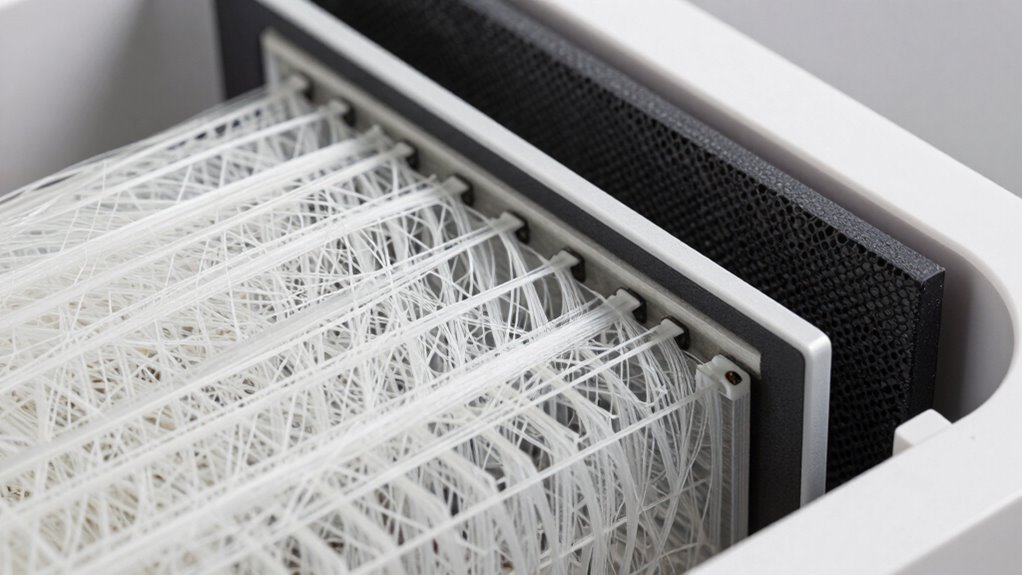
HEPA filters are designed to effectively trap tiny particles that cause allergies and respiratory issues. When air passes through, these filters use a dense fiber structure to capture particles as small as 0.3 microns. This includes airborne viruses, pollen, dust mites, and pet dander. HEPA filters utilize multiple mechanisms—interception, impaction, and diffusion—to remove particles from the air. Larger particles are caught by impaction and interception, while smaller particles, like airborne viruses, are captured through diffusion, where random movement increases contact with fibers. This efficient particle removal enhances allergen removal and reduces airborne contaminants. As a result, HEPA filters considerably improve indoor air quality, making the environment safer for allergy sufferers and those with respiratory sensitivities.

Air Purifiers for Home Bedroom Large Room Up to 1092 Ft² 1Hr AHAM Verified
- AHAM Verified Performance: Certifies dust, smoke, pollen removal
- Large Room Coverage: Covers up to 1,092 ft² with 1 ACH
- Dual-Side Air Intake: Efficient purification with patented design
As an affiliate, we earn on qualifying purchases.
As an affiliate, we earn on qualifying purchases.
How Do Carbon Filters Remove Odors and Gases?

Carbon filters remove odors and gases mainly through activated carbon adsorption and chemical reactions. As air passes through, odors stick to the porous surface of the carbon, trapping unwanted molecules. Sometimes, chemical reactions further neutralize gases, making the air cleaner and fresher. Additionally, the porous surface of activated carbon provides a large surface area that enhances its ability to adsorb contaminants effectively.
Activated Carbon Adsorption
How do carbon filters effectively eliminate odors and gases from the air? They rely on activated carbon’s porous structure to trap molecules through a process called adsorption, a key part of air purification and filter technology. When air passes through the filter, gases and odors are attracted to the carbon’s surface and adhere to it. This makes carbon filters especially good at removing strong smells, volatile organic compounds (VOCs), and chemicals from the air. To give you a clearer picture:
- Activated carbon acts like a sponge for gases
- Its large surface area traps pollutants efficiently
- It works best for odors and chemicals, not particles
- Regular replacement keeps it effective
- The porous structure of activated carbon is what makes it so effective at trapping gases and odors.
This process ensures your space smells fresher and the air is safer to breathe.
Chemical Reaction Processes
While adsorption is the primary way activated carbon captures gases and odors, chemical reactions also play a vital role in breaking down certain airborne pollutants. When gases pass through the carbon filter, some react chemically with the carbon’s surface, transforming into less harmful substances. These chemical reactions can neutralize odorous compounds or convert toxic gases into safer molecules. Measurement accuracy is essential in monitoring the effectiveness of these chemical transformations over time. Over time, however, the carbon becomes saturated, reducing its effectiveness. To restore its filtering power, the process of filter regeneration occurs—either through thermal or chemical methods—that removes accumulated contaminants and reactivates the carbon’s surface. This cycle allows the filter to continue capturing pollutants efficiently, ensuring consistent odor and gas removal without needing frequent replacement.

MOOKA Air Purifiers for Home Large Room up to 1076ft², H13 True HEPA Air Filter Cleaner, Odor Eliminator, Remove Smoke Dust Pollen Pet Dander, Night Light, B-D02L White
- Large Coverage Area: Covers up to 1076 ft² with 6 air changes/hour
- Effective HEPA Filtration: Captures pet dander, smoke, dust, pollen, odors
- Quiet and Energy Efficient: Operates at 20dB, energy-saving brushless motor
As an affiliate, we earn on qualifying purchases.
As an affiliate, we earn on qualifying purchases.
HEPA vs. Carbon Filters: Which Is More Effective for Your Needs?

Choosing between HEPA and carbon filters depends on what you need to remove from your air. HEPA filters excel at capturing tiny particles, while carbon filters are better for odors and gases. Consider their maintenance needs and costs to find the most effective option for your situation. Understanding cycling gear maintenance can also help prolong the life of your filters and improve overall air quality.
Particle Removal Capabilities
When it comes to removing particles from the air, HEPA filters and carbon filters play distinct roles. HEPA filters excel at trapping tiny particles due to their high filtration efficiency, capturing particles as small as 0.3 microns. They’re ideal for allergens, dust, and pet dander. Carbon filters, on the other hand, don’t focus on particle size but absorb gases and odors, making them less effective for particle removal. Proper filter selection is essential to ensure your air quality meets your specific needs. Consider these points: – HEPA filters target small particles for maximum filtration efficiency – Carbon filters are better at removing gases and odors – HEPA filters can trap particles down to 0.3 microns – Carbon filters don’t filter out tiny particles but excel at chemical absorption Choose based on whether particle size or gas removal matters most for your environment.
Odor and Gas Filtration
Are you wondering which filter type works best for removing odors and gases? If improving air quality is your goal, carbon filters are highly effective because they adsorb volatile organic compounds, smoke, and strong odors. Their filter efficiency in targeting gases makes them ideal for kitchens, smoking areas, or homes with pets. HEPA filters, on the other hand, excel at capturing tiny particles but don’t considerably reduce odors or gases. If eliminating smells and harmful gases is your priority, a carbon filter will deliver better results. Combining a HEPA filter with a carbon filter can optimize air quality, addressing both particles and gases. Additionally, understanding the filtering mechanisms of these technologies helps in choosing the right solution for your needs. Ultimately, for odor and gas filtration, carbon filters are more specialized and effective for your needs.
Maintenance and Cost
While both HEPA and carbon filters require regular maintenance to keep them working effectively, their costs and upkeep differ markedly. HEPA filters generally have a longer filter lifespan, often lasting 6 to 12 months, depending on usage. Carbon filters, on the other hand, tend to need replacement every 1 to 3 months due to saturation. Proper filter maintenance is essential to ensure optimal performance and air quality. Here’s what to take into account:
- HEPA filters typically cost more upfront but last longer, reducing frequent replacements.
- Carbon filters have a lower initial price but may incur higher ongoing costs due to more frequent changes.
- Maintenance involves replacing filters at recommended intervals to guarantee ideal performance.
- Cost comparison shows that, over time, HEPA filters might be more economical, especially in large spaces.
Ultimately, your choice depends on your budget and specific air quality needs.
Where Should You Use HEPA and Carbon Filters in Your Home or Office?
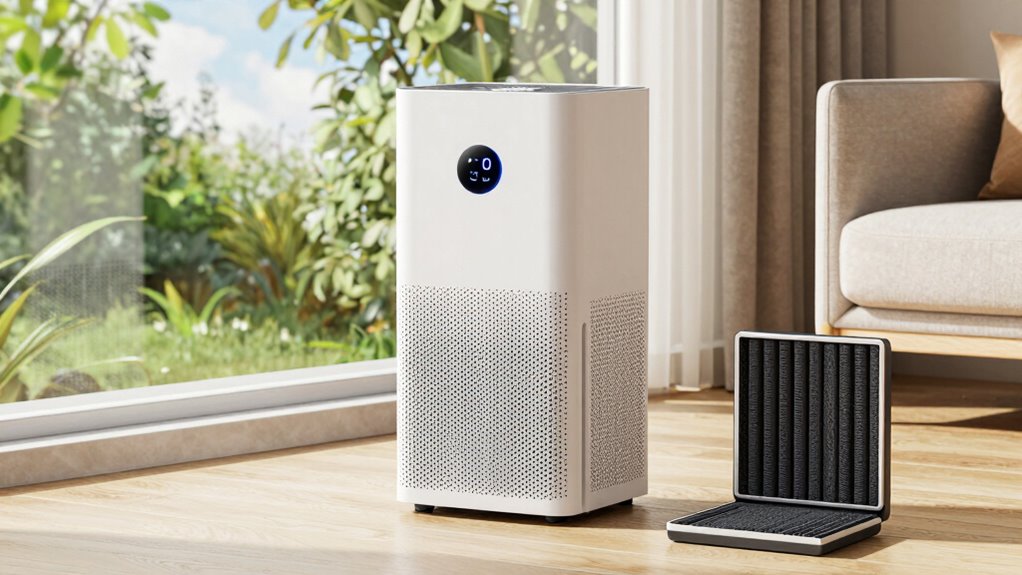
Knowing where to place HEPA and carbon filters in your home or office can substantially improve indoor air quality. Proper air purifier placement ensures ideal filtration and extends filter lifespan. HEPA filters work best in bedrooms or living areas with dust, allergens, or pet dander. Carbon filters excel in kitchens or smoking zones to absorb odors and chemicals. Consider placing filters near sources of pollution for maximum efficiency. Avoid blocking airflow and ensure filters aren’t in direct sunlight to prevent degradation. Here’s a quick guide:
| Area | Recommended Filter Type | Tips |
|---|---|---|
| Bedroom | HEPA | Reduce allergens and dust |
| Kitchen | Carbon | Eliminate cooking odors |
| Living Room | HEPA | Improve overall air quality |
| Smoking Area | Carbon | Absorb tobacco smoke |
| Near Pets | HEPA | Capture pet dander |
Additionally, understanding the horsepower of electric dirt bikes can help you choose equipment suited for your needs, whether for off-road adventures or commuting.
Can You Use HEPA and Carbon Filters Together?
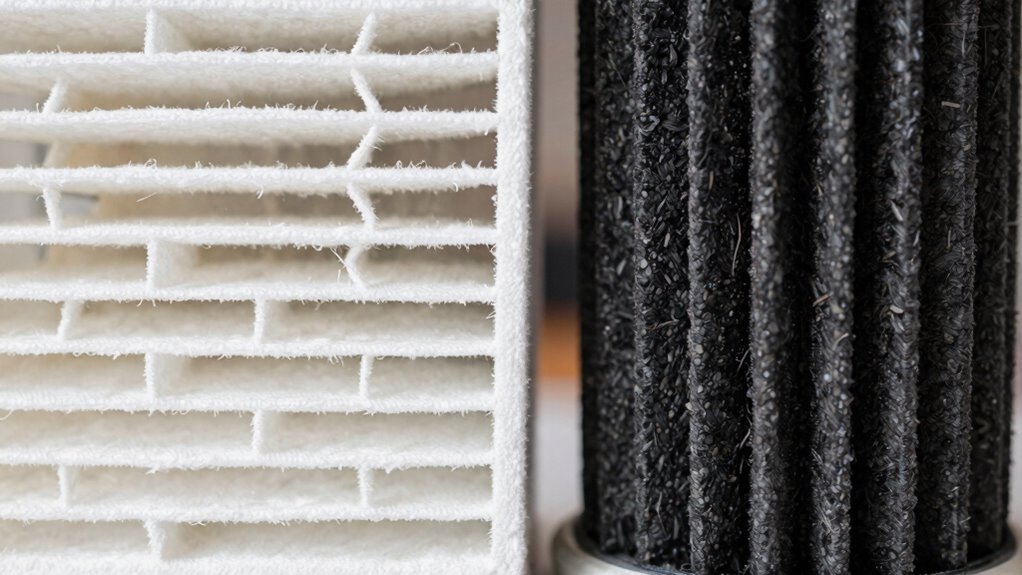
Have you wondered whether using HEPA and carbon filters together can boost your indoor air quality? The answer is yes, combining these filters can enhance air purification by tackling different pollutants. HEPA filters excel at capturing airborne particles like dust, pollen, and pet dander, while carbon filters absorb odors, gases, and volatile organic compounds. When used together, they provide a thorough filtration system. Just make sure of filter compatibility to avoid restricting airflow or overloading your device. Additionally, understanding regional flavors and chicory/coffee insights can help you appreciate how different environments may influence air quality needs. Consider these points:
- Use compatible filters designed for your air purifier
- Install filters in the correct order (carbon first or last)
- Check if your device supports dual filtering
- Regularly maintain both filters for peak performance
This combo can markedly improve your indoor air quality.
How to Maintain and Replace Your Air Filters for Long-Lasting Clean Air

Regularly maintaining and replacing your air filters is essential to keep your indoor air clean and your purifier working efficiently. Knowing your air filter lifespan helps you plan when to change it before it becomes clogged or less effective. To extend the filter’s life, check it monthly and clean or vacuum around it if possible. Follow filter replacement tips like turning off the purifier before changing the filter, wearing gloves, and ensuring you install the new filter correctly. Keep an eye on signs of reduced airflow or strange odors, which indicate it’s time for a replacement. Proper maintenance not only improves air quality but also prolongs the life of your air purifier, saving you money and ensuring long-lasting clean air in your home.
Frequently Asked Questions
Are HEPA and Carbon Filters Suitable for Industrial Air Purification?
Yes, HEPA and carbon filters are suitable for industrial applications, but their effectiveness depends on your specific needs. HEPA filters excel at capturing fine particles, while carbon filters remove odors and gases. You need to take into account filter maintenance regularly to guarantee peak performance. Evaluate your air quality requirements carefully, and choose the right combination of filters to improve safety and air purity in your industrial environment.
How Do Filter Sizes Impact Their Effectiveness?
You should know that smaller filter sizes improve particle retention, making filters more effective at capturing tiny pollutants. The filter material’s density and pore size directly impact this, so choosing a filter with appropriately small pores guarantees it traps harmful particles efficiently. Larger filters may allow smaller particles to pass through, reducing overall effectiveness. Consequently, selecting the right size based on your air quality needs is crucial for ideal filtration.
Can HEPA and Carbon Filters Remove Viruses From the Air?
You might think HEPA and carbon filters can completely remove airborne pathogens like viruses, but they don’t eliminate all threats. HEPA filters are highly effective at trapping particles, including many viruses, thanks to advanced filter technology. However, carbon filters mainly target gases and odors. To maximize protection against airborne pathogens, use a HEPA filter in your air purifier, but remember, no filter guarantees 100% virus removal.
What Are the Environmental Impacts of Disposing Used Filters?
When you dispose of used filters, consider the environmental impacts, such as waste and potential pollution. You can reduce this by participating in filter recycling programs, which help repurpose materials and minimize landfill waste. Proper disposal methods are vital for the environment, so follow local guidelines to lessen your carbon footprint and guarantee safe disposal, ultimately protecting ecosystems from harmful contaminants released during filter disposal.
Are There Hybrid Filters Combining HEPA and Carbon Functionalities?
Yes, hybrid filters combining HEPA and carbon functionalities exist. These combined filters use hybrid technologies to effectively trap airborne particles while also absorbing odors and gases. You’ll find them in some advanced air purifiers, offering the convenience of one device handling multiple air quality concerns. By choosing a combined filter, you get all-encompassing filtration, making your indoor air cleaner, fresher, and healthier without the need for multiple filters.
Conclusion
Choosing between HEPA and carbon filters depends on your needs; one captures tiny particles, the other tackles odors and gases. While HEPA filters excel at trapping allergens, carbon filters remove stubborn smells. Using both provides thorough air cleaning, but neglecting regular maintenance can undermine their effectiveness. Remember, clean air isn’t just about what filters you choose—it’s about how well you care for them. Ultimately, a balanced approach ensures your air stays fresh and healthy.