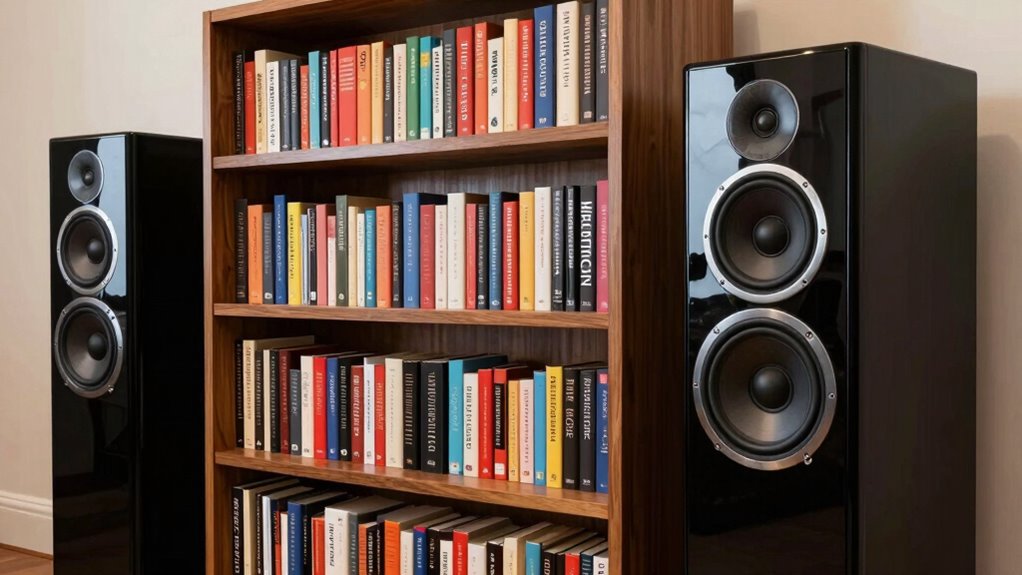

If you have limited space, bookshelf speakers are a great choice since they fit on shelves or stands and still deliver impressive sound quality. Floorstanding speakers are larger and better for filling bigger rooms with full-range sound, but they require more room and careful placement. Both types can sound excellent with proper positioning, though floorstanders tend to produce more bass. To optimize your setup and choose what’s right for your space and sound needs, keep exploring further.

Get the little things that make your day delivered free with Prime
- Fast, free delivery on millions of items
- Prime Video, Amazon Music and more included
- Member-only deals all year
Key Takeaways
- Bookshelf speakers save space and are ideal for smaller rooms, but may have limited bass compared to floorstanding models.
- Floorstanding speakers deliver richer, fuller sound suitable for large spaces, but require more room and careful placement.
- Proper positioning enhances sound quality for both types, with floorstanders being more sensitive to wall proximity.
- Room acoustics significantly influence performance; managing reflections benefits both speaker types.
- Tradeoffs involve balancing size, room space, sound fullness, and placement flexibility to suit specific listening environments.
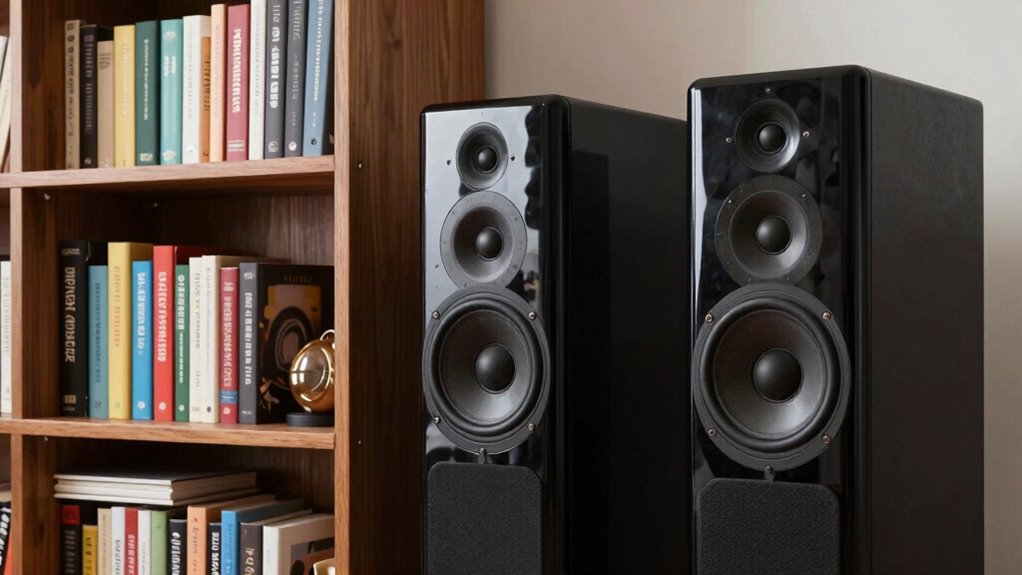
Are bookshelf and floorstanding speakers fundamentally different, or can they serve similar roles in your home audio setup? The answer depends largely on your space, listening preferences, and how well you understand room acoustics and speaker placement. Bookshelf speakers are compact and designed to fit on shelves or stands, making them ideal for smaller rooms or setups where space is limited. Floorstanding speakers, on the other hand, are larger, typically standing directly on the floor, and are built to fill bigger rooms with full-range sound. While they seem quite different physically, they can sometimes produce similar audio experiences if you optimize their placement and account for room acoustics. Proper speaker placement is crucial to achieving optimal sound quality, regardless of the type you choose. In smaller spaces, bookshelf speakers can deliver impressive sound quality without overwhelming the room. Since they’re closer to ear level when placed on stands or shelves, they often provide clearer imaging and better stereo separation, especially if you pay attention to speaker placement. Positioning is vital; placing them too close to walls or corners can muddy the sound, so you want to experiment with distance from walls and height to get the best balance. Good speaker placement helps manage room acoustics, reducing unwanted reflections or bass boominess that can distort your listening experience. Recognizing how sound interacts with your environment can make a significant difference in your listening experience. Additionally, understanding room acoustics can help you further optimize your speaker setup for the best possible sound. Recognizing how sound interacts with your environment can make a significant difference in your listening experience. Floorstanding speakers, with their larger drivers, naturally produce more bass and can fill larger rooms with sound. However, their size means they’re more sensitive to placement. To optimize their sound, you need to think about how far they sit from walls and corners, as these surfaces influence bass response and overall clarity. Proper placement ensures you avoid excessive resonance or muddiness caused by poor positioning. While they can produce a full, rich sound with less effort—because of their design—they still benefit from adjustments based on your room’s acoustics. If you don’t pay attention to speaker placement, even high-end floorstanders might sound off, with muddled bass or echoing treble. Learning speaker positioning techniques can help you unlock the full potential of your speakers.
bookshelf speakers for small rooms
As an affiliate, we earn on qualifying purchases.
As an affiliate, we earn on qualifying purchases.
Frequently Asked Questions
Which Speaker Type Offers Better Durability Over Time?
You’ll find that floorstanding speakers generally offer better durability over time because of their material longevity and sturdier construction. They’re built with stronger materials designed to withstand regular use, while bookshelf speakers may require more careful maintenance due to their smaller size and more delicate components. If you want long-term reliability, floorstanding models tend to be a better investment, as they typically need less frequent maintenance and resist wear better over the years.
How Do Aesthetics Influence Speaker Choice?
Aesthetics play a subtle yet significant role in your choice, as visual appeal and design integration can make or break your space’s vibe. You probably want speakers that blend seamlessly with your decor, enhancing the room’s style without overpowering it. Whether you prefer sleek, modern lines or a classic look, your choice should complement your environment, making listening a joy that’s as visually pleasing as it is acoustically satisfying.
Can Bookshelf Speakers Be Upgraded Easily?
Yes, you can upgrade bookshelf speakers easily. You just need to take into account speaker placement carefully for ideal sound, and you can customize the sound by swapping out components like the drivers or adding sound-absorbing materials. Upgrading allows you to improve audio quality without replacing the entire system. Keep in mind, however, that some upgrades may require technical know-how or professional assistance to guarantee compatibility and performance.
What Are the Cost Differences Between the Two?
Imagine you’re setting up a home theater on a budget. Typically, bookshelf speakers cost less upfront, often ranging from $50 to $300, making them a budget-friendly choice. Floorstanding speakers usually start around $200 and can go over $1,000 for premium models. The price comparison shows that bookshelf speakers often provide a more affordable option, but for bigger sound and deeper bass, you might need to invest in higher-end floorstanding options.
How Does Room Acoustics Affect Each Type’s Performance?
Room acoustics profoundly impact both bookshelf and floorstanding speakers. You’ll notice reflections bouncing off walls, affecting clarity and soundstage. Bookshelf speakers benefit from sound absorption treatments to reduce reflections, making them ideal for smaller rooms. Floorstanding speakers, being larger, can handle more reverberation but may need strategic placement to minimize room reflections. Adjusting your room’s acoustics enhances performance, regardless of the speaker type.
floorstanding speakers for large spaces
As an affiliate, we earn on qualifying purchases.
As an affiliate, we earn on qualifying purchases.
Conclusion
Imagine choosing a trusty lighthouse or a towering skyscraper. Your bookshelf speakers are the lighthouse, compact but bright, guiding sound with precision in a cozy space. Floorstanders are the skyscraper, tall and commanding, filling large rooms with grandeur. Both have their charm, but it’s your space and sound needs that decide which to build. Whether guiding ships or reaching new heights, your choice shapes your personal soundscape—one’s a beacon, the other a skyline.
speaker stands for bookshelf speakers
As an affiliate, we earn on qualifying purchases.
As an affiliate, we earn on qualifying purchases.
As an affiliate, we earn on qualifying purchases.
NFL season / tailgating Picks
team gear
As an affiliate, we earn on qualifying purchases.