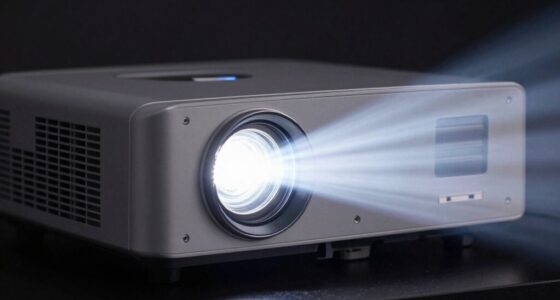

If you have a small room, a short throw projector is your best choice because it can project large images from just a few feet away, reducing shadows and clutter. They’re compact, easy to install, and designed to work well in tight spaces without distortion. Standard projectors need more room and might cause image distortion in small areas. Keep exploring to find out more about which option suits your space better.

Get the little things that make your day delivered free — and shop member deals
- Fast, free delivery on millions of items
- Access to Prime Big Deal Days deals on October 6–7
- Prime Video, Amazon Music and more included
Key Takeaways
- Short throw projectors are ideal for small rooms due to their ability to project large images from minimal distance.
- They reduce shadows and obstructions, making setup easier in tight spaces.
- Standard projectors require more room, making them less suitable for small or confined areas.
- Short throw models typically consume less power and generate less heat, ideal for small, enclosed spaces.
- Image quality and minimal distortion can be achieved with both types, but short throw projectors offer better keystone correction in limited spaces.
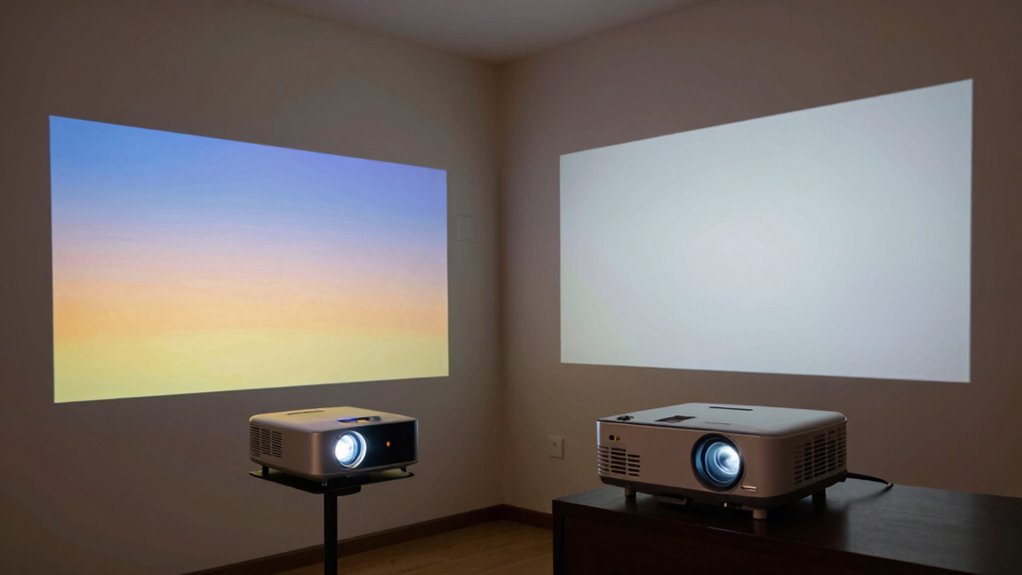
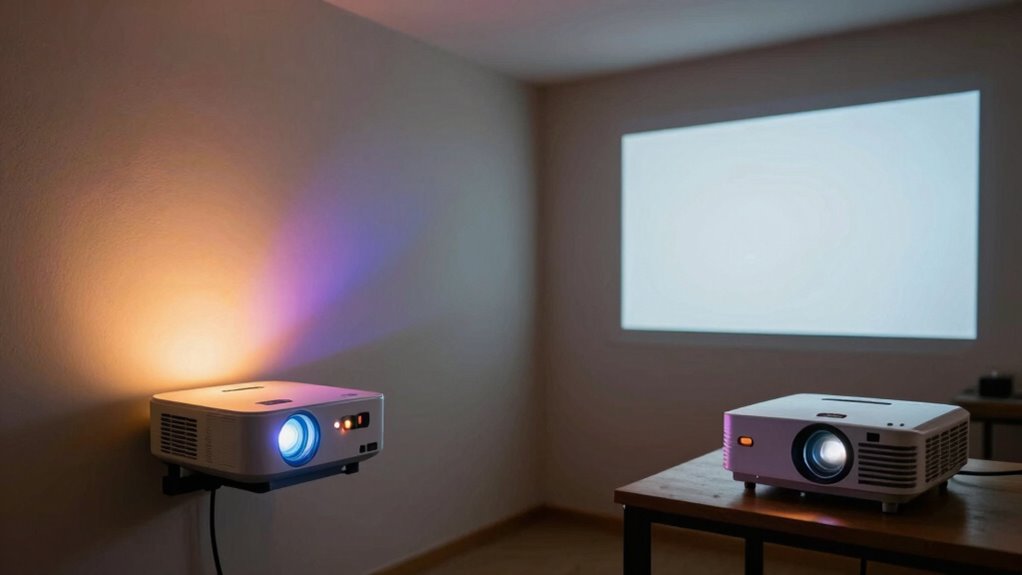
When choosing a projector, understanding the difference between short throw and standard models is essential, especially since the right choice can substantially impact your setup and viewing experience. If you’re working with a small room, this decision becomes even more critical. Short throw projectors are designed to project large images from a very close distance, often just a few feet from the wall or screen. This means you can place them right next to furniture or walls without worrying about shadows or glare. On the other hand, standard projectors require a larger space to create the same size image, often needing several feet or even yards of distance.
In terms of image quality, both projector types can deliver sharp, vibrant visuals, but their performance depends heavily on the specific model. Short throw models tend to have advanced lens technology that compensates for their proximity, resulting in crisp images with minimal distortion. They’re particularly good for small rooms because they reduce keystone effects and ensure the image remains square and aligned, which is vital when space is limited. Standard projectors, however, often have larger, more powerful lenses that can produce larger images in bigger rooms but might struggle with image distortion or brightness issues if the room isn’t well controlled or if the projector isn’t properly calibrated.
Power consumption is another factor to think about. Generally, short throw projectors consume less power because they are smaller and have lower wattage lamps, making them more energy-efficient for small spaces. This not only saves on electricity bills but also minimizes heat output, keeping your small room cooler and more comfortable. Additionally, advancements in projection technology continue to improve efficiency and image quality across both types. Some newer models also feature energy-saving modes, which further enhance their suitability for small, enclosed environments.
Choosing between the two also depends on your specific needs. If you want a setup that’s easy to install in a tight space and reduces shadows or obstructions, a short throw projector is the way to go. Its compact size and low power consumption make it ideal for small rooms with limited space. If your room is larger or you plan to project images that need to be bigger than what a short throw can comfortably produce, a standard projector might be better, even if it requires a more extensive installation. Ultimately, your choice should balance image quality, power efficiency, and the spatial constraints of your small room for the best viewing experience.
short throw projector for small rooms
As an affiliate, we earn on qualifying purchases.
As an affiliate, we earn on qualifying purchases.
Frequently Asked Questions
Which Projector Type Offers Better Color Accuracy for Small Rooms?
Short throw projectors generally offer better color accuracy for small rooms because their display technology and design minimize distortions and color shifts caused by proximity. They often come with advanced color calibration features, ensuring more precise color reproduction. Standard projectors may struggle with color consistency in tight spaces, but with proper calibration, they can also deliver good results. Overall, short throw projectors tend to provide superior color accuracy in small room setups.
How Does Ambient Light Affect Short Throw Versus Standard Projectors?
Ambient light can wash out your projector image, causing screen glare and reducing clarity. Short throw projectors, positioned close to the screen, are more sensitive to ambient brightness, making glare more noticeable. Standard projectors, placed farther away, tend to handle ambient light better but still suffer if the room isn’t dark enough. To keep images sharp and vibrant, control ambient brightness and minimize stray light, regardless of your projector type.
Are Maintenance Costs Different Between Short Throw and Standard Projectors?
Maintenance costs are generally similar for both short throw and standard projectors, but installation challenges can differ, affecting your long-term upkeep. Short throw projectors might require more precise installation, potentially increasing initial setup costs. Noise levels are usually comparable, but if a projector runs louder, it can impact your environment. Overall, both types need regular lamp replacements and cleaning, so plan for ongoing maintenance regardless of your choice.
Can Both Types Project Onto Curved or Uneven Surfaces Effectively?
Both projectors can face curved surface challenges and uneven projection issues, but short throw models often handle uneven surfaces better due to their closer distance and reduced distortion. Standard projectors may struggle more with curved or uneven surfaces, creating distorted images. You’ll want to choose a projector with keystone correction or warping features to help compensate for these issues, making your display clearer and more consistent across irregular surfaces.
Which Projector Type Is More Energy-Efficient for Small Room Setups?
A short throw projector is generally more energy-efficient for small rooms because it requires less power to operate at a close distance, reducing power consumption. Its design often leads to better energy savings, especially with modern LED or laser models that consume less power overall. You’ll find that short throw projectors not only save energy but also help lower your electricity costs, making them a practical choice for small room setups.
As an affiliate, we earn on qualifying purchases.
Conclusion
In the end, choosing between a short throw and a standard projector boils down to your room size and needs. Think of it like the difference between a pocket watch and a sundial—each has its place in time. If space is tight, a short throw is your knight in shining armor, saving you from clutter. But if room size isn’t an issue, a standard projector might just be the key to a grander viewing experience. The choice is yours—may the pixels be ever in your favor.
energy-efficient short throw projector
As an affiliate, we earn on qualifying purchases.
As an affiliate, we earn on qualifying purchases.
best standard projector for large spaces
As an affiliate, we earn on qualifying purchases.
As an affiliate, we earn on qualifying purchases.
Fall Picks
fall essentials
As an affiliate, we earn on qualifying purchases.